


Armenia cornered as mediators make public Karabakh peace plan


By Kamal Ali
An agreement on visa facilitation signed between Azerbaijan and the European Union in November comes into force this summer. Starting from September, Azerbaijani citizens will be able to receive EU visas much easier and at discounted prices, according to Malena Mard, head of the EU office in Baku.
Russia’s reaction to Azerbaijan’s relations with the EU is quite adequate as the Kremlin does not see anything threatening to its interests. We no longer receive messages threatening with deportation of Azerbaijani immigrants from Russia. The closure of the Gabala radar station in Azerbaijan and the complete withdrawal of Russian troops from the country are things of the past and forgotten already.
Azerbaijan, for its part, has no intention of joining the EU and NATO. It has consistently distanced itself from European values, clamping down on liberal journalists and human rights activists. These are the things the Russians love to see.
Some good news came from the Russian capital the other day: the director of the Moscow Conservatory banned the “state ensemble of Artsakh” from performing in the Rakhmanina Hall at the request of the Azerbaijani embassy in Moscow. The advertisement of the show was also removed from the conservatory website.
All this is happening against a backdrop of the latest statement by the OSCE Minsk Group, which is tasked with mediating a peaceful settlement of the Nagorno-Karabakh conflict. After years of intense talks between the two countries, the Minsk Group announced six principles for the resolution of the long-running dispute.
A lot has been said in the media about these principles. I can only say Armenia is required to withdraw its occupying forces from seven Azerbaijani districts around Nagorno-Karabakh first.
While Baku says it accepts these principles and is happy with the peace plan, the Armenian minister of defense says “no” and the country’s foreign minister keeps mum, meaning "yes", as he himself took an active part in hammering out these six principles.
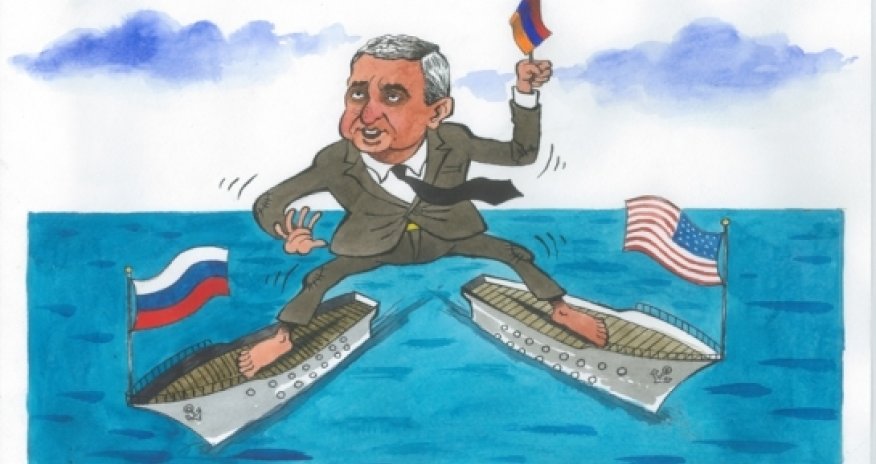
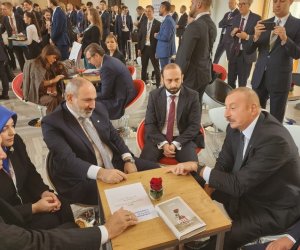
One may only guess who is in charge in Armenia. That person may not be President Serzh Sargsyan, whose silence is deafening. He probably expects a short notice from Russian Foreign Minister Sergey Lavrov, reading "Shut up and sign." He received a similar notice just before signing rapprochement protocols with Turkey in Switzerland.
The OSCE Minsk Group is co-chaired by Russia, the U.S. and France. By his silence, Sargsyan shows disrespect to all three superpowers. He is afraid of saying 'no', and tries to stage a political show in Xankandi, capital of Nagorno-Karabakh. When the U.S. co-chair, James Warlick, visited the city, he faced a group of young protesters holding banners. The impression was that Karabakh has its own six principles, all saying "no"s.
It is as though they (Karabakh Armenians) are being asked something or there is anything that depends on them.
A brilliant combination has taken shape: only one figure, Sargsyan, has remained on the chessboard. Gone are pawns and everything else except for the girls on the main square in Nagorno-Karabakh.
So, Azerbaijan, Turkey, the U.S., France and Russia share the same position while Armenia is left alone.
As a way out of the situation, Armenian political analysts see a new brief war in Karabakh where Sargsyan will simulate resistance before withdrawing from exactly the same seven districts, or from two to three districts at best.
Everybody will be satisfied with the outcome: Sargsyan will say he had to pull his troops out of the districts in face of the difficult military and political circumstances. Azerbaijan will celebrate its “victory” while the super powers will boast of helping resolve such a complicated conflict.
Russia's interest in this scenario is much more concrete and significant as it will get the right to deploy its “peacekeepers” in the conflict zone, thus gaining an additional leverage over the regional countries.
What will come next? Another 20 years of negotiations on the fate of another chunk of Azerbaijani territory. A lot will change on the ground by the time. New frontiers will emerge, new economic interests will arise, the demographic picture of the region will change. Much more will happen that you cannot predict today.
Bakudaily.az




 Photo
Photo 
 Video
Video