



United States and Armenia agree on mechanism to implement TRIPP project
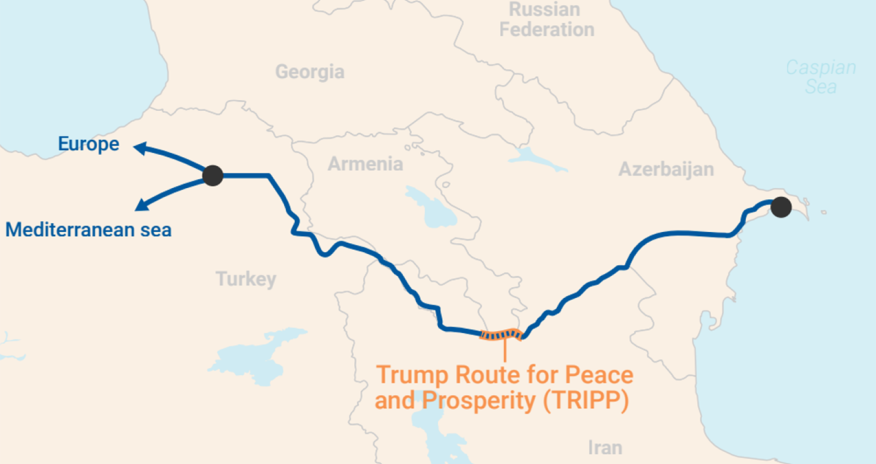


Armenian Foreign Minister Ararat Mirzoyan and U.S. Secretary of State Marco Rubio agreed on a framework for implementing the Trump Route for International Peace and Prosperity (TRIPP) during talks in Washington.
The U.S. Department of State released the joint statement, saying the framework marks another step toward fulfilling commitments undertaken at the White House on August 8, 2025, aimed at promoting sustainable peace in the South Caucasus.
According to the statement, the framework sets out a practical path for implementing TRIPP, including the creation of seamless multimodal transport connectivity across Armenia. The project is expected to provide a land link between mainland Azerbaijan and its Nakhchivan Autonomous Republic, while also forming a key segment of the Trans-Caspian trade route.
The document underscores that the implementation of TRIPP is based on the principles of sovereignty, territorial integrity and reciprocity, reaffirmed at the August 8, 2025 Peace Summit hosted by U.S. President Donald Trump. The ultimate goal of the project is to strengthen prosperity and security in Armenia and Azerbaijan, while supporting U.S. trade by expanding regional transport and trade links connecting Central Asia and the Caspian region with Europe.
Armenia’s Foreign Ministry released further details, saying private operators will be involved in implementing TRIPP in Armenia, while the United States will provide technical assistance, including inspection and customs clearance procedures and screening technologies.
The framework stresses that Armenia’s sovereignty and jurisdiction over border and customs operations are non-negotiable. Border management will operate under an international “front office–back office” model. Armenia plans pilot projects to streamline pre-clearance procedures, digitise documentation and introduce a “single window” border-crossing concept.
Private operators hired by TRIPP Development Company will handle initial document collection, user information and consulting services, fee collection and payment processing for trade and transit. Armenian authorities will maintain a physical presence at all border and customs facilities, and sovereign functions will not be outsourced. Any private security personnel must be licensed in Armenia.








 Photo
Photo 

 Video
Video