





Watch a star explode 20,000 years ago:
14.06.2014 14:30


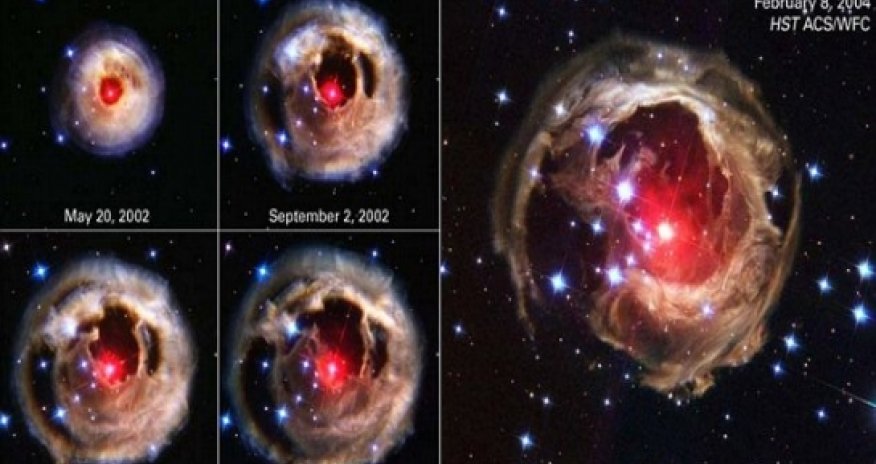
The majestic transformation of a star has been revealed in a stunning time-lapse of a stellar explosion 20,000 light years away.The animation, spanning four years, documents a huge explosion emanating from V838 Monocerotis – a red star located in the constellation Monoceros.Before it exploded, V838 had grown to become one of the largest stars ever observed by astronomers, producing 600,000 times more light than our own sun.As it burst, V838 created an expanding light echo that lit up the cosmic dust surrounding it, creating some of the most stunning images seen by the Hubble telescope to date.The time-lapse uses a series of images captured by Hubble between 2002 and 2006, when V838 Monocerotis produced a stellar flash so brilliant that scientists had never seen anything like it before.A stellar flash like this was unprecedented because supernovas and novas typically expel matter out into space, often obscuring them from view.While the animation appears to show V838 expel material into space, what it is actually showing is an outwardly moving 'light echo' of the bright flash - about a million times solar luminosity.According to Nasa, during echoes, light from the flash is reflected by successively more distant rings in the complex array of ambient interstellar dust that already surrounded the star.Structures that resemble whirlpools in the star are noticeable in the time-lapse, and may have been produced by the effects of magnetic fields in the space between the stars.Scientists still don’t know what caused the explosion. They originally predicted that astronomers were watching a supernova or the thermal pulse of a dying star.But these theories have since been dismissed after discovering the V838 was likely a young star.A paper with contributions from the US Naval Observatory, the University of Arizona and the European Space Agency concluded: 'When combined with the high luminosity and unusual outburst behaviour, these characteristics indicate that V838 Mon represents a hitherto unknown type of stellar outburst, for which we have no completely satisfactory physical explanation.'V838 Mon lies about 20,000 light years away toward the constellation of the unicorn (hence the name Monoceros), while the light echo in the image spans about six light years in diameter.(dailymail.co.uk) Bakudaily.az











Latest news 
More news

 Photo
Photo 



 Video
Video