





'Godzilla of Earths' identified
03.06.2014 20:00


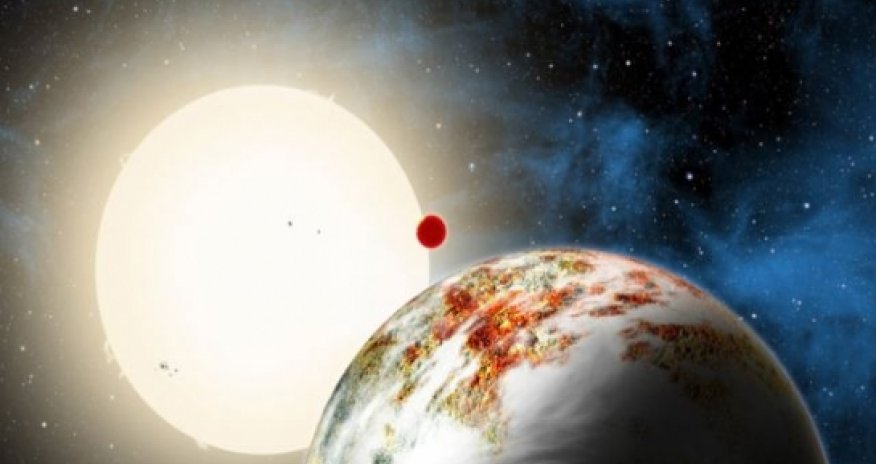
There is a new class of planet out there that astronomers are calling the "mega-Earth".It is an object with a hard surface like our own world but much, much bigger.The necessity for the new designation follows the discovery of a planet which has a mass some 17 times that of Earth.Known as Kepler-10c, it orbits a star about 560 light-years away. Scientists described its properties at an American Astronomical Society meeting in Boston.They confess it is something of a head-scratcher.Theorists had always thought that any planet that large would pull so much hydrogen on to itself that it would look more like a Neptune or a Jupiter."The proper way to call it is something bigger than a 'super-Earth, so how about 'mega-Earth," Prof Dimitar Sasselov, of the Harvard-Smithsonian Center for Astrophysics (CfA), told reporters. He also used the phrase, "the Godzilla of Earths!".Kepler-10c, as the name suggests, was detected by the US space agency's Kepler telescope.This finds new worlds by looking for the tiny dip in light as they pass in front of their parent stars.The technique gives a diameter - in this case, 29,000km, or just over two times the width of Earth - but not a mass.For that, astronomers looked at 10c with the Harps-North instrument on the Telescopio Nazionale Galileo in the Canary Islands.It extracts a mass measurement by examining the gravitational interaction between the planet and its host star.Combined with the diameter, the mass number showed that Kepler-10c cannot be a gaseous world but must comprise very dense material."It's 17 - in fact, it's more than 17 - Earth masses, and that brings the density to 7.5 grams per cubic centimetre, which is a lot more than what we know of rock here on Earth (5.5g/cm3)," said Prof Sasselov."But remember, this is a very massive planet, which means those same minerals are highly compressed."So, what you see in the density is mostly due to compression rather than different composition. The composition comes out as being a combination of rocks and some volatiles, probably 5-15% at most of water."Interestingly, the age of the host star is about 11 billion years old, which is early in the evolution of the Universe when generations of exploding stars have not had long to make the heavy elements needed to construct rocky planets."Finding Kepler-10c tells us that rocky planets could form much earlier than we thought. And if you can make rocks, you can make life," says Prof Sasselov.(BBC)Bakudaily.az











Latest news 
More news

 Photo
Photo 



 Video
Video