





Five thousand years of tattoos - PHOTO
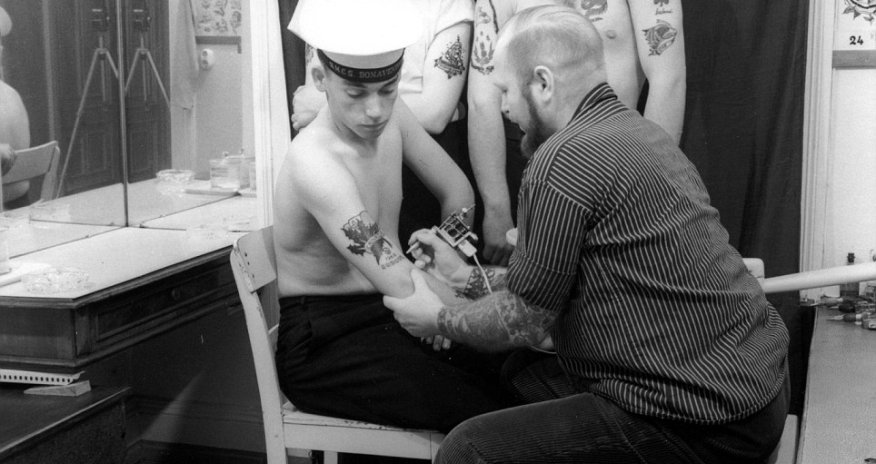


While tattoos are a relatively recent phenomenon in Europe and the US, body art has long been part of Polynesian culture and has also been found on the mummified remains of Ancient Egyptian priests and priestesses.Now, the 5,000-year-old history of tattooing has been brought to life in a fascinating new exhibition at the Musée du Quai Branly, which charts the evolution of body art over the centuries.Although tattoos first made an appearance on the bodies of neolithic men and woman and again in the woad etchings of Iron Age Britons, they didn't reappear in Western culture until the 19th century and the first recorded body art craze which originated in Victorian high society.Popularised by 19th century explorers returning home to the UK full of tales about the weird and wonderful tattooed women they saw on their travels, tattoos swiftly became the accessory of choice for upper class women.Such was the intensity of the craze for body art during the Victorian period, even Queen Victoria is believed to have had one in the form of a Bengal tiger fighting with a pythonBy contrast, in many Oriental, African and Pacific cultures, tattoos have long played a significant part in the religious and ceremonial life of communities - and continue to do so in some.In the West, however, tattoos were seen as marginalising and were often used to mark slaves or stigmatise wrongdoers, as was the case with Colbert's Code noir (black code) in France, which marked criminals and prostitutes.At the beginning of the 1830s in North America, sideshows set up their caravans around the big top of travelling circuses. They were the itinerant expression of the dime museum, where fairground attractions and anatomical phenomena were exhibited: the armless and legless man, the bearded lady and the person tattooed 'from head to toe'. In these antechambers of the sensational, which often employed seasonal or itinerant tattooers, the tattooed performer moreover became a sword-swallower, an animal-tamer, a fireeater, a telepathist, a wrestler, a knifethrower.Meanwhile Europe, which had always been fond of 'curiosities' in which the marvellous, the farce and scientific illusions merged, welcomed these artists with open arms. Thanks to these performers, the spectacle of the tattooed body entered its golden age at the start of the 20th Century.Less willing to embrace the art, Christianity outlawed tattooing. It was prohibited in Leviticus and the New Testament, then officially repressed in 787 by the second Council of Nicaea. It was still practiced, however, by pilgrims in the Middle Ages and even today by the Copts, Armenians and Christians of the Holy Land. But all that changed in the 1700s, when tattoos came to be seen as a mark of rebellion and free-thinking, and were adopted by bohemian society as well as members of the armed forces.Sailors, in particular, got tattoos to mark the lands they had voyaged to: a turtle meant crossing the Equator, an anchor signified he had traversed the Atlantic, while a dragon symbolised he had travelled East.By the end of the 19th century, tattoos had become part of mainstream society, although some still retained their original connotations. A particularly noxious part of Victorian Britain was the kidnap and forcible tattooing of women, who were then press-ganged into work as circus attractions.Although the popularity of tattooing remained buoyant throughout the 1920s, 30s and 40s, the post-war period saw inking consigned to the wilderness once more.Left to languish in the fashion wilderness for nearly 40 years, the tattoo next staged a comeback in the 1970s, when they were claimed by the nascent feminist movement before becoming part of the body-conscious beautifying of the 1980s and then gaining mainstream status in the 1990s.Now, with tattooing popular once more, the Paris museum hopes that the Tatoueurs, Tatoués exhibition, which is curated by journalists Anne and Julien of the quarterly French contemporary art magazine Hey!, will prove popular.'Tattooing is part of the common heritage of most of humanity,' say the pair. 'We wanted to do this exhibition for a long time because we feel it's important to show that tattooing has a real history and is a pure product of humanity.(dailymail.co.uk)Bakudaily.az










Latest news 
More news

 Photo
Photo 



 Video
Video