




Palaeoartist brings human evolution to life with amazingly realistic sculptures
12.05.2014 22:36


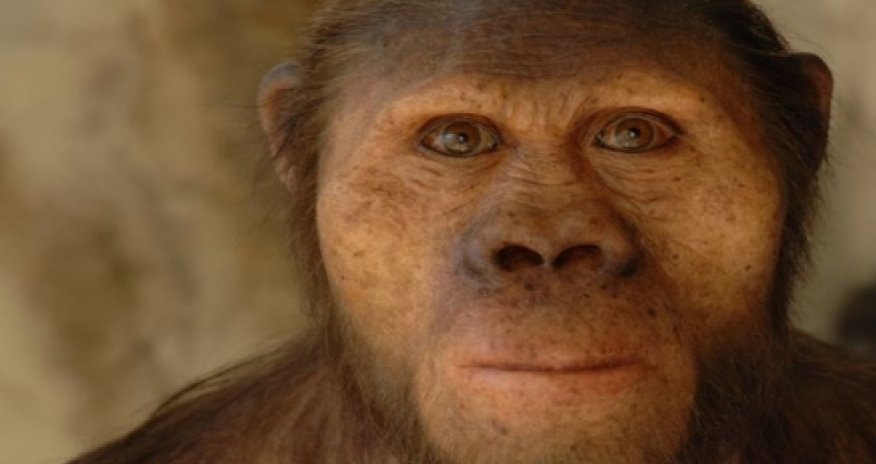
From freckles and blemishes to staring glass eyes, hyper-realistic models of early hominids are now providing an eerie way of coming face-to-face with our ancient ancestors and distant cousins.The sculptures as if like they could come to life at any second, thanks to the incredible attention to detail of ’palaeoartist’ Elisabeth Daynès.Having initially wanted to make masks for theatre, she became interested in human evolution over her 20 year career has recreated Lucy – the famed Australopithecus afarensis specimen that lived between three million and two million years ago - as well as a host of other hominids and Homo erectus.Her work has been exhibited in museums across the world, which is informed by scientific research, brought to life by sculpting techniques in her Parisian studio.‘I have a clear vocation – to reveal the secrets of ancient bones and evidence of the past. 'To give those distant beings their face, their identity, their humanity back,' she said.‘I became obsessed with skulls. I wanted to give a face to every skull I saw. The goal wasn’t any longer to contribute to the making of a play or film, but to decipher the origins of mankind.’Ms Daynès’ first challenge was to reconstruct a woolly mammoth and a group of Magdalenian people who lived around 11,000 years ago. To make her models, which include the tiniest of details from wrinkles to goose pimples, she starts with a thorough examination of the specimen’s skull, which marks out many distinctive hominid groups.Ms Daynès and her team now make computer models of the skulls using 18 data points on the bone, which gives her an idea of muscles, the shape of a hominid’s nose, forehead and chin.She then uses clay to mould the facial features - informed by her research - across a cast taken from the skull in question, while examining extra bones and teeth give her more of an idea of the creature’s stature.‘I always follow the same rigorous two-step protocol: First, I focus on highlighting the general features of the fossil group to which the skull belongs; then I reveal the particular traits of the subject,’ she said.Once the clay sculpture is complete, a silicone cast is made, onto which all the tiny details can be painstakingly painted, such as veins, wrinkles and spots. Eye prosthetics give the eerily realistic stare and dental prosthetics the sculptures’ toothy grins.It can be difficult to decide on exact details such as eye and hair colour, so Ms Daynès references scientific literature, which reveals that Neanderthals had red hair, among other findings.‘Following the same approach as in a forensic investigation, I use the clues I find on the fossil to create an ID of the subject: fossil group, dating, age at death, probable sex, diseases, deficiencies, dietary pattern, associated fauna, climate, living conditions, environment, culture, etc. ‘I collect all these data in long discussions with experts, palaeopathologists, anthropologists and anatomists, to guide the decisions I make at each step of the reconstruction process, and to make sure my creations take into account the latest scientific developments.‘Finally, I painstakingly implant the hair, beard, and body hair one by one.’Ms Daynès uses human hair for members of the Homo genus, but mixes in yak hair for earlier hominids, as their hair is thought to have been much thicker and coarser.She said that every model is the ‘synthesis of all the knowledge on the origins of humankind’.‘What I try to do is to provide an opportunity for the general public to come face to face with beings millions of years away from them, an encounter with a different kind of humanity.’She works particularly hard on giving the models a gaze by adding wrinkles of expression and putting shade and light into the eyes until the subject is animated with emotion.Ms Daynès believes that prehistoric humans are too often associated with brutality, but she tries to capture their humanity. And it can be hard for her to say goodbye to her creations, which typically take months to make.‘I spend so much time with those creatures, sharing such a close relationship with their bodies and faces that I tend to find them beautiful,’ she said.‘A reconstruction project makes me enter into a relationship that resembles an act of love. When my sculptures go to a museum or an exhibition venue, I miss them acutely. I feel anxious for them and hope they are treated well.’(dailymail.co.uk)Bakudaily.az








Latest news 
More news

 Photo
Photo 



 Video
Video