





Humans become WEAKLINGS compared with our ancient ancestors
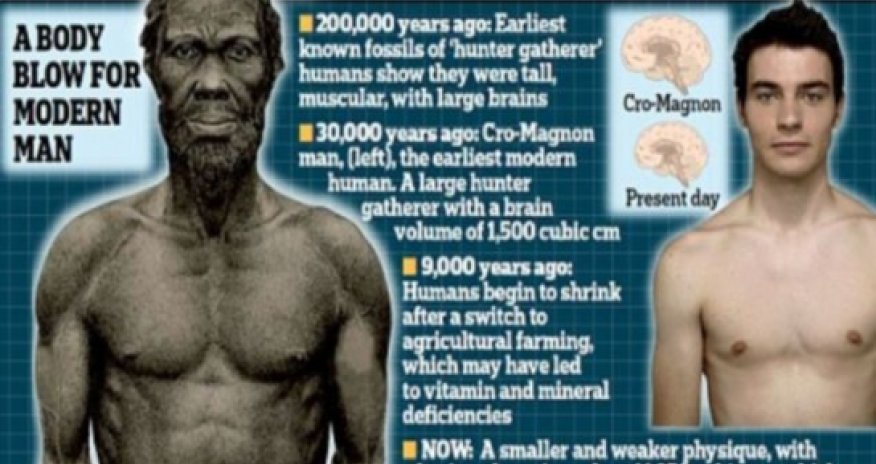


Scientists claim if they were to cross paths, our ancestors would have been capable of outrunning some of the world’s most talented athletes. That's according to recent research by Cambridge University which reveals just how far our fitness has fallen in just a couple of millennia.‘Even our most highly trained athletes pale in comparison to these ancestors of ours,’ Dr Colin Shaw told Outside Magazine. ‘We’re certainly weaker than we used to be.’The study looked at skeletons dating back to around 5,300 BC with the most recent to 850 AD - a time span of 6,150 years.It then compared the bones to that of Cambridge University students, and found the leg bones of male farmers 5,300 BC were just as good as those of highly-trained cross-country runners.But just 3,000 years later, the study found our ancestors had leg bone structures closer to that of the Netflix-watching generation.When our ancestors made the transition from hunter-gatherer societies to agricultural ones, their lower limb strength and overall mobility decreased.Men were most affected by the change, which suggested a reduction in mobility and loading. In other words, they were covering less distance on foot and carrying out lighter physical tasks.‘My results suggest that, following the transition to agriculture in central Europe, males were more affected than females by cultural and technological changes that reduced the need for long-distance travel or heavy physical work,’ said lead researcher Alison Macintosh, from the department of archaeology and anthropology at Cambridge University.‘This also means that, as people began to specialise in tasks other than just farming and food production, such as metalworking, fewer people were regularly doing tasks that were very strenuous on their legs.’Macintosh used a portable 3D laser surface scanner to study the femurs, or thigh bones, and tibiae, or shin bones, of skeletons from Germany, Hungary, Austria, the Czech Republic and Serbia.She found that male tibiae became less rigid and the bones of both men and women became less strengthened to loads in one direction more than another.‘Both sexes exhibited a decline in anteroposterior, or front-to-back, strengthening of the femur and tibia through time, while the ability of male tibiae to resist bending, twisting, and compression declined as well,’ said Macintosh.She presented her findings at the annual meeting of the American Association of Physical Anthropologists in Calgary, Canada.Evidence of declining mobility in women was less consistent than for men. This suggested they were ‘multi-tasking’ - or at least undertaking fewer tasks requiring significant lower limb loading.‘In central Europe, adaptations in human leg bones spanning this time-frame show that it was initially men who were performing the majority of high-mobility tasks, probably associated with tending crops and livestock.‘But with task specialisation, as more and more people began doing a wider variety of crafts and behaviours, fewer people needed to be highly mobile, and with technological innovation, physically strenuous tasks were likely made easier.‘The overall result is a reduction in mobility of the population as a whole, accompanied by a reduction in the strength of the lower limb bones.’(dailymail.co.uk)ANN.Az










Latest news 
More news

 Photo
Photo 



 Video
Video