





Galaxy pictured when our universe was just 650 million years old
10.02.2014 18:30


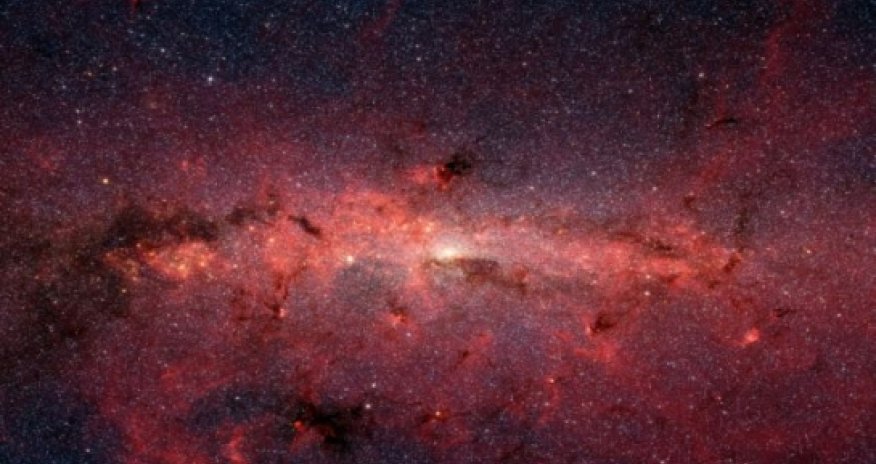
NASA's Spitzer and Hubble Space Telescopes have spotted one of the most distant galaxies ever seen.The galaxy, known as Abell2744 Y1, harks back to a time when our universe was only about 650 million years old, compared to its current age of 13.8 billion years.It is about 30 times smaller than our Milky Way galaxy and is producing about 10 times more stars, as is typical for galaxies in our young universe.The discovery comes from the Frontier Fields program, which combines Nasa'a space telescopes.Spitzer sees infrared light, Hubble sees visible and shorter-wavelength infrared light, and NASA's Chandra X-ray Observatory sees X-rays. The telescopes are also getting a boost from natural lenses: they peer through clusters of galaxies, where gravity magnifies the light of more distant galaxies.The Frontier Fields program will image six galaxy clusters in total. Hubble images of the region are used to spot candidate distant galaxies, and then Spitzer is needed to determine if the galaxies are, in fact, as far as they seem.Spitzer data also help determine how many stars are in the galaxy.These early results from the program come from images of the Abell 2744 galaxy cluster. The distance to this galaxy, if confirmed, would make it one of the farthest known.Astronomers say it has a redshift of 8, which is a measure of the degree to which its light has been shifted to redder wavelengths due to the expansion of our universe.The farther a galaxy, the higher the redshift. The farthest confirmed galaxy has a redshift of more than 7. Other candidates have been identified with redshifts as high as 11.'Just a handful of galaxies at these great distances are known,' said Jason Surace, of NASA's Spitzer Science Center at the California Institute of Technology, Pasadena. 'The Frontier Fields program is already working to find more of these distant, faint galaxies. 'This is a preview of what's to come.'The findings, led by astronomers from the Instituto de Astrofísica de Canarias and La Laguna University, set to be published in the the journal Astronomy and Astrophysics Letters.(dailymail.co.uk)ANN.Az











Latest news 
More news

 Photo
Photo 



 Video
Video