





Earth looks surprisingly small in this picture taken from Mars - PHOTO
07.02.2014 18:27


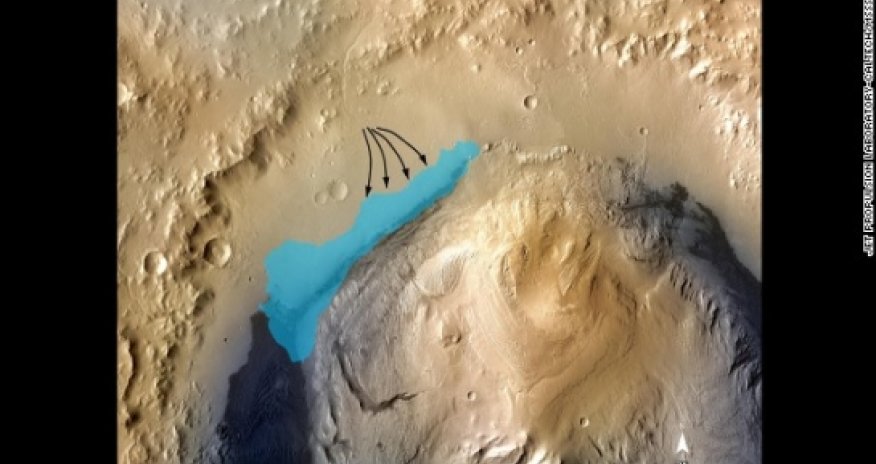
It's a dot in the sky.But not just any dot. For the Curiosity rover, it's home.NASA tweeted a photo Thursday taken by Curiosity from the Mars surface six days earlier. The image shows a speck above the horizon that a pointer identifies as Earth."Look Back in Wonder," reads the accompanying text from the Curiosity Rover's official Twitter feed. "My 1st picture of Earth from the surface of Mars."If it's possible for a 1-ton, roughly SUV-size vehicle to get homesick, it's had plenty of reason to shed a tear. The last time Curiosity was on Earth was November 26, 2011, when it set off aboard a NASA spacecraft from Cape Canaveral, Florida.Eight and a half months and some 352 million miles later, the rover landed safely on Mars with its 17 cameras and other assorted scientific instruments all intact. And almost as quickly, the Curiosity -- the centerpiece of a $2.6 billion project -- began transmitting images back to Earth.But until now, none of those pictures actually showed Earth itself.The one released by NASA, which was "processed to remove effects of cosmic rays," was taken about 80 minutes after Mars' sunset with what researchers call Curiosity's "left eye camera" on its "Mastcam." It show not just Earth but another dot that NASA says is our moon. (Earth was about 99 million miles away at that point, according to NASA's Jet Propulsion Laboratory. Curiosity traveled a much longer distance to get to Mars because both planets are constantly in motion.)Any Martian or Earthling who happened to be visiting wouldn't need such a special camera to see the same thing.According to NASA, "A human observer with normal vision, if standing on Mars, could easily see Earth and the moon as two distinct, bright 'evening stars.'"Of course, photographing its native planet isn't Curiosity's main mission, which is exploring Mars.Since landing in Gale Crater, Curiosity has helped scientists determine that an area called Yellowknife Bay was habitable in ancient times.Here, from the rim of the crater came stream waters that formed "a lake-stream-groundwater system that might have existed for millions of years," John Grotzinger, lead scientist on the Curiosity mission, wrote in last month's edition of the journal Science.(CNN)ANN.Az











Latest news 
More news

 Photo
Photo 



 Video
Video