




What the Earth would look like stripped of oceans
11.08.2015 14:30


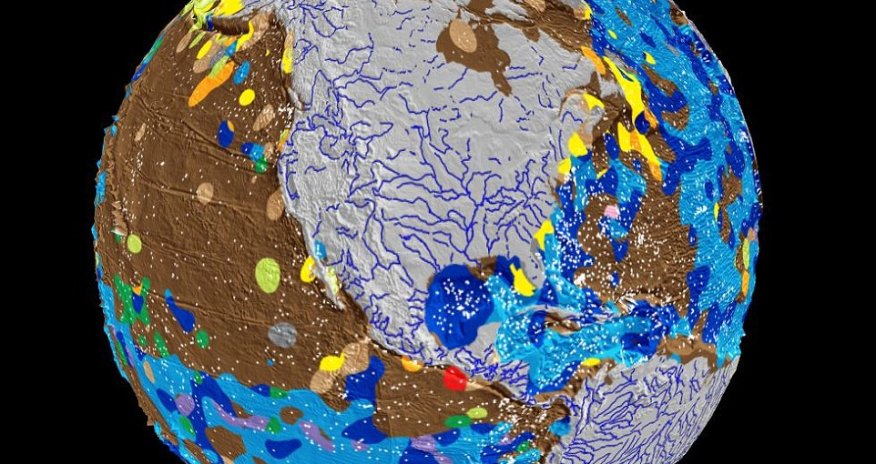
This is the first ever digital map of the Earth's seafloor, revealing deep ocean basins to be much more complex than previously thought.
The last complete map was hand-drawn in the 1970s.
But now, following half a century of research collating around 15,000 samples from research ships, the University of Sydney's School of Geosciences has developed an unprecedented impression of the world in stunning detail.
The map, published in the latest edition of Geology, offers fresh insights into the depths of the world's oceans, which make up 70 per cent of the Earth's surface, and how they have been affected by climate change.
Crucially, researchers found, much of the seafloor is not covered in clay but a 'complex patchwork of microfossil remains'.
To emphasise the sheer scale of the data, lead researcher Dr Adriana Dutkiewicz teamed up with National ICT Australia (NICTA) big data experts to use algorithms to develop an interactive map.
'Recent images of Pluto's icy plains are spectacular, but the process of unveiling the hidden geological secrets of the abyssal plains of our own planet was equally full of surprises!' co-author Dr Simon O'Callaghan from NICTA said.
While researchers have recently experimented with satellite data-gathering to build impressions of the Earth's surface, this method - acoustic beams from ships - is deemed to be the most accurate.
Dr Dutkiewicz said the primary benefit of this research will be to enhance our understanding of climate change.
'In order to understand environmental change in the oceans we need to better understand what is preserved in the geological record in the seabed,' said Dr Dutkiewicz.
'The deep ocean floor is a graveyard with much of it made up of the remains of microscopic sea creatures called phytoplankton, which thrive in sunlit surface waters.
'The composition of these remains can help decipher how oceans have responded in the past to climate change... We urgently need to understand how the ocean responds to climate change.'
It will also pave the way for marine research voyages 'aimed at better understanding the workings and history of the marine carbon cycle,' Dr Dutkiewicz added. Some speculate it will even be useful for oil exploration.
Much of North America, particularly on the West side, is surrounded by siliceous mud, a sediment commonly made up of phytoplankton shells.
Australasia's landscape became a key focus of the study as the data quickly began to disprove much of what scientists believe to be true about the region.
The seafloor they found, is complex, deep and covered in microfossil remains.
According to the map, which shows an aura of light blue around Australia, the sea bed is largely made up of calcareous ooze, which is a calcium carbonate mud formed from free-floating organisms. The research team will now set their sights on the relationship between this part of the ocean bed and the surface waters to understand the significance.
'Australia's new research vessel Investigator is ideally placed to further investigate the impact of environmental change on diatom [the most common form of phytoplankton] productivity,' said Dr Dutkiewicz.
The old map suggests much of the Southern Ocean around Australia is mainly covered by clay blown off the continent, whereas our map shows this area is actually a complex patchwork of microfossil remains.
'Life in the Southern Ocean is much richer than previously thought.'
The digital map comes after a landmark study in 2014, when researchers at the University of California, San Diego, used satellites to build impressions of mountains - 'seamounts' - which lie beneath miles of sediment on the ocean floor.
The 2014 study laid bare the lack of information on the buried tectonic structures.
Previously unseen features include newly exposed continental connections across South America and Africa, and new evidence for seafloor spreading ridges at the Gulf of Mexico that were active 150 million years ago.
(dailymail.co.uk)


www.ann.az


Instagram
Follow us on Instagram
Similar news
Similar news

Society 13:30
Students Without Final Academic Evaluation Ineligible for School Diplomas — Deputy Minister





 Photo




 Video


