





Latest images reveal Pluto's hazy horizon
29.05.2020 02:17


Fresh images from Nasa's New Horizons spacecraft have captured a low-lying haze clinging to the surface of Pluto.
The pictures also offer stunning views of the dwarf planet's rugged mountains and its sweeping plains.
New Horizons acquired a mass of observations as it whipped past Pluto on 14 July, at a distance of 12,500km.
Scientists say the haze provides further evidence for the equivalent on Pluto of Earth's water-cycle, but involving exotic types of ice.
The spacecraft began a year-long data dump earlier this month, allowing scientists to resume their analysis of the world's fascinating topography and tenous atmosphere.
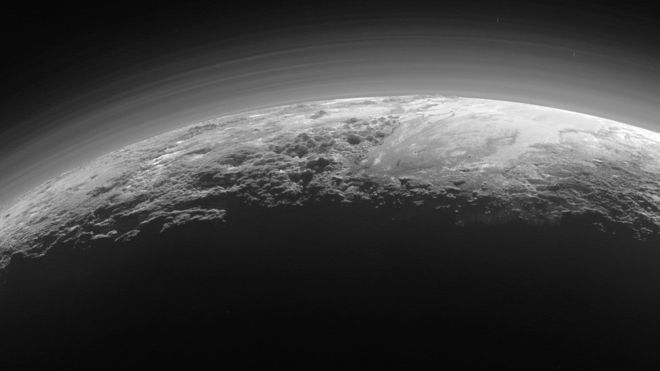
A new, oblique view of Pluto's crescent was downlinked to Earth on 13 September. Dramatic backlighting from the Sun helps highlight the dwarf planet's diverse terrain and more than a dozen layers of haze in its atmosphere - extending from near the ground to at least 100km (60 miles) above the surface.
Prof Alan Stern, the mission's chief scientist, said: "This image really makes you feel you are there, at Pluto, surveying the landscape for yourself."
He added: "But this image is also a scientific bonanza, revealing new details about Pluto's atmosphere, mountains, glaciers and plains."
Alien weather
The picture also shows a bank of fog-like, low-lying haze illuminated by the setting sun against Pluto's dark side, and interfused with shadows from nearby mountains.
"In addition to being visually stunning, these low-lying hazes hint at the weather changing from day to day on Pluto, just like it does here on Earth," said mission scientist Will Grundy, from the Lowell Observatory in Arizona.
Along with other observations, the image hints at an Earth-like hydrological cycle involving frozen nitrogen and other soft ices.
"Driven by dim sunlight, this would be directly comparable to the hydrological cycle that feeds ice caps on Earth, where water is evaporated from the oceans, falls as snow, and returns to the seas through glacial flow," explained Alan Howard, a team member from the University of Virginia in Charlottesville.
Prof Stern commented: "Pluto is surprisingly Earth-like in this regard, and no one predicted it."
Pictures of the dwarf planet released last week by Nasa revealed a field of dark, aligned ridges, which look like wind-blown dunes.
New Horizons is next scheduled to visit a second icy object in the distant region of our Solar System known as the Kuiper Belt.
The US space agency will carry out a review of the plan to fly by the comet-like 2014 MU69 before officially approving the mission's extension.
(BBC)
www.ann.az


Twitter
Follow us on Twitter

Similar news
Similar news









Society 18:00
Over 690 kg of Drugs Seized from 60 Foreign Nationals in Azerbaijan Over the Past 10 Months



 Photo




 Video