



HIV breakthrough could lead to a CURE
12.10.2015 18:00


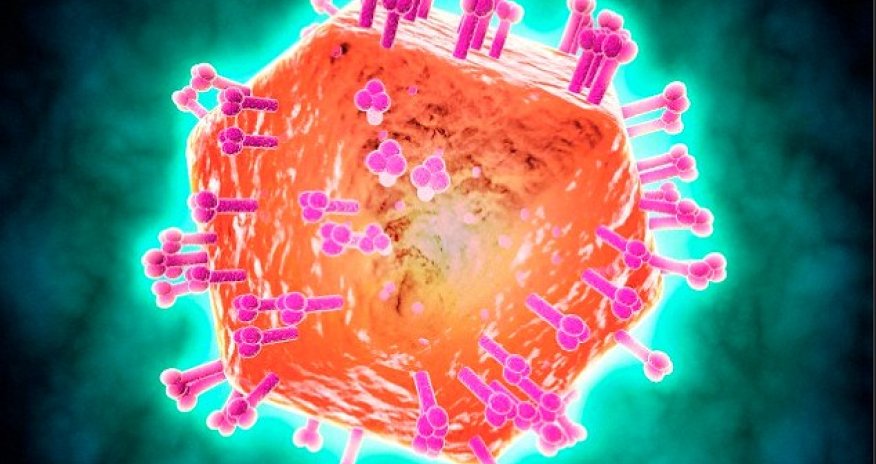
The way a patient's immune system responds to HIV infection could offer clues as to whether they will go on to achieve remission after drug treatment, scientists have discovered.
The breakthrough sheds light on the phenomenon known as 'post-treatment control' - where the virus remains undetectable in some patients even after medication is stopped.
The findings could open new avenues for understanding post-treatment control of the virus, and ultimately the eradication of HIV, Dr John Frater said.
The Oxford University professor said: 'Normally, if someone is being treated for HIV infection and they stop their medication, the virus can be detected back in the blood stream within days.
'We have been trying to find out why this is not true in all patients.
'But, that in some people the virus remains undetectable for months, and even years after stopping treatment.
'Understanding this might help us develop new treatments, and ultimately a cure for HIV infection.'
He added: 'Our work has identified that there are certain markers on the immune cells of patients which seem to predict who can stop therapy and stay well.
'Interestingly, some of these markers have also been shown to be good targets for therapy in some cancers.
'We hope now to find out more about these markers - and others - to discover if new strategies for treating or even curing HIV might be possible.'
Working with researchers at the University of New South Wales, the team at Oxford analysed data from a patient trial where anti-retroviral therapy was interrupted at 48 weeks.
Anti-retroviral therapy has dramatically improved life-expectancy for people with HIV.
Recent studies have advised patients should start the treatment as soon as they are diagnosed with HIV, rather than is currently the practise, and the therapy is delayed until a patient's viral load reaches a certain level.
But the drug treatment is not a cure.
The infection persists in latent cells, 'hidden' reservoirs, from where they can re-emerge.
Destroying these reservoirs remains one of the 'Holy Grails' of HIV research.
For some patients, whose anti-retroviral treatment was started at an early stage, they have gone on to experience 'remission' periods of 10 years or more, after stopping the therapy.
Dr Frater and his team analysed the data from a study of patients with primary HIV infection involved in the SPARTAC trial.
They compared the T-cells - a type of white blood cell that forms part of the body's immune system - of 154 patients in Europe, Brazil and Australia, who had their anti-retroviral treatment interrupted after 12 or 48 weeks.
From there, they came up with a shortlist of 18 immune system biomarkers.
And from that list, they identified three - PD-1, Tim-3 and Lag-3, to be statistically significant predictors of when the virus would rebound.
The researchers found that in patients where high levels of these three biomarkers attached to 'exhausted' T-cells prior to patients beginning anti-retroviral therapy, they were more likely to experience an earlier rebound, post treatment.
They note theirs is the first study to ever show the finding.
Professor Rodney Phillips, a former Oxford don and now dean of medicine at the University of New South Wales, played an instrumental role.
His 2003 proposal to conduct immunology and virology of the patients receiving ART during the SPARTAC trial, provided researchers with the data they needed to make the discovery 10 years later.
Professor Phillips said: 'The SPARTAC study will never be able to be replicated again and it has provided us with a once-in-a-lifetime opportunity to look at the causes of viral rebound in this particular group of patients with HIV.
'Focusing on the exhaustion markers was an important step as it has given us vital clues as to why some people are able to better control the virus after therapy has been interrupted.'
His colleague at the UNSW, Professor Anthony Kelleher, one of the study's co-authors, said understanding the mechanisms that allow HIV to remain in 'remission' is essential if the virus is to be eradicated.
(dailymail.co.uk)
www.ann.az


Telegram
Follow us on Telegram


Similar news
Similar news


Society 13:30
Students Without Final Academic Evaluation Ineligible for School Diplomas — Deputy Minister






 Photo




 Video


