





Mutant mosquitoes 'resist malaria'
25.11.2015 17:30


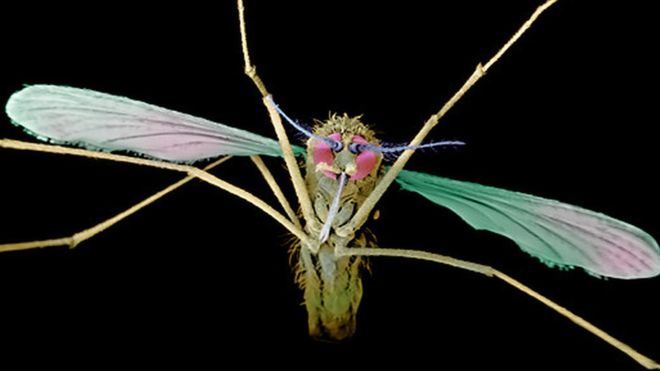
US scientists say they have bred a genetically modified (GM) mosquito that can resist malaria infection.
If the lab technique works in the field, it could offer a new way of stopping the biting insects from spreading malaria to humans, they say.
The scientists put a new "resistance" gene into the mosquito's own DNA, using a gene editing method called Crispr.
And when the GM mosquitoes mated - their offspring inherited the same resistance, PNAS journal reports.
In theory, if these mosquitoes bite people, they should not be able to pass on the parasite that causes malaria.
About 3.2bn people - almost half of the world's population - are at risk of malaria.
Bed nets, insecticides and repellents can help stop the insects biting and drugs can be given to anyone who catches the infection, but the disease still kills around 580,000 people a year.
'Pivotal role'
Scientists have been searching for new ways to fight malaria.
The University of California team believe their GM mosquito could play a pivotal role - breeding resistant offspring to replace endemic, malaria-carrying mosquitoes.
They took a type of mosquito found in India - Anopheles stephensi - on which to experiment.
Dr Anthony James and his team showed that they could give the insect new DNA code to make it a poor host for the malaria parasite.
The DNA, which codes for antibodies that combat the parasite, was inherited by almost 100% of the mosquito offspring and across three generations.
The researchers say the findings offer hope that the same method could also work in other mosquito species.
Although it would not be a sole solution to the malaria problem, it would be a useful additional weapon, they say.
Prof David Conway, UK expert from the London School of Hygiene & Tropical Medicine, said: "It's not the finished product yet but it certainly looks promising. It does look like the genetic editing works."
Other scientists have been looking at genetically modifying mosquitoes to render them infertile, so that they die out. But some experts fear that eliminating mosquitoes entirely may have unforeseen and unwanted consequences. Replacing disease-carrying mosquitoes with harmless breeds is a potential alternative.
(BBC)
www.ann.az


Instagram
Follow us on Instagram
Similar news
Similar news






Society 18:00
Over 690 kg of Drugs Seized from 60 Foreign Nationals in Azerbaijan Over the Past 10 Months




Latest news 
More news 
 Photo




 Video


