





Frigid Pluto is home to more diverse terrain than expected
18.03.2016 21:03


The most detailed look at Pluto's surface to date has revealed an unexpected range of mountains, glacial flows, smooth plains and other landscapes, according to studies released on Thursday.
The unprecedented window into the so-called dwarf planet, which orbits the sun like other planets but is smaller, comes via high-resolution photographs from NASA’s New Horizons spacecraft. The interplanetary space probe made the first-ever visit to Pluto and its five moons last July.
Those images, chemical analyses and other data show a complex, geologically active world 3 billion miles from Earth, with an underground ocean and volcanoes that appear to spew ice, five research papers published in this week’s Science journal said.
"It’s a pretty wild place geologically,” said planetary scientist William McKinnon of Washington University in St. Louis, Missouri.
Another scientist described the diversity of landscapes as "astonishing."
How the varied terrain came to be remains a mystery for the distant Pluto, which has an average surface temperature of minus 380 degrees Fahrenheit (minus 229 degrees Celsius).
Scientists suspect several processes at work, including vaporization of volatile ices, such as nitrogen, carbon monoxide and methane, into Pluto’s cold and unexpectedly compact atmosphere.
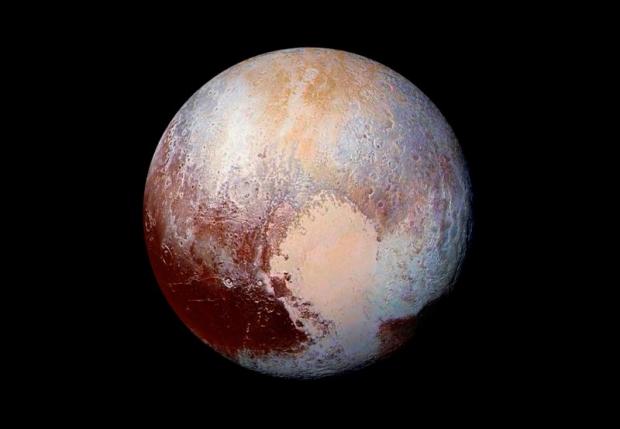
Though smaller than Earth's moon, Pluto likely still has enough internal heat from its formation some 4.5 billion years ago to help maintain its most prominent feature, a smooth, 620-mile (1,000-km) wide, heart-shaped basin known as Sputnik Planum.
Relatively young mountains west of Sputnik Planum and mounds to the south are harder to explain. Scientists suspect both rest on blocks of water ice, though how that came to exist on Pluto is unknown.
"We are puzzled by almost everything,” said Alan Stern, the New Horizons mission's lead scientist.
The studies show that Pluto’s primary moon, Charon, had an active life but ran out of naturally occurring radioactive heat in its rocks and froze through about 2 billion years ago.
Scientists now believe Charon and Pluto’s four other small moons owe their existence to a crash between Pluto and another Pluto-sized body early in the solar system’s history.
Similar to Earth’s moon, scientists suspect Pluto’s natural satellites were formed from the debris that was hurled into space after the crash.
(reuters.com)
www.ann.az


Youtube
Follow us on Youtube


Similar news
Similar news






Society 18:00
Over 690 kg of Drugs Seized from 60 Foreign Nationals in Azerbaijan Over the Past 10 Months




Latest news 
More news 
 Photo




 Video


