





Row over protection for World Cup mascot armadillo - PHOTO
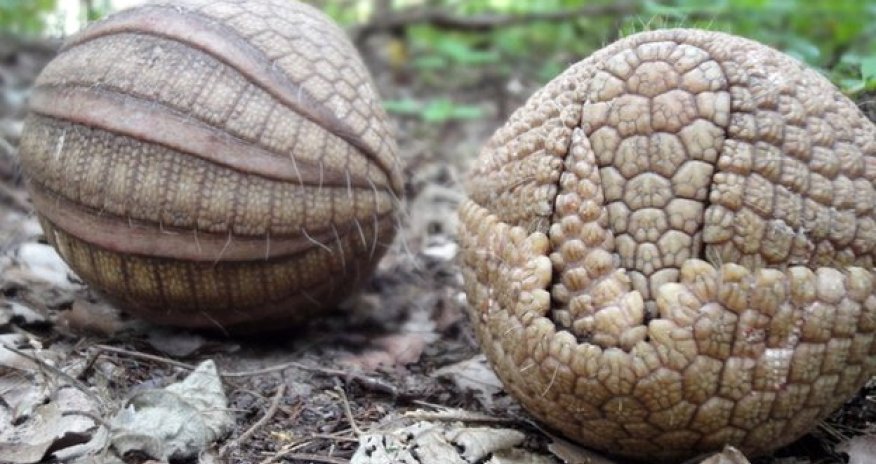


The Brazilian three-banded armadillo is listed as a vulnerable species and is the basis of the Fuleco mascot that will feature on official merchandise and souvenirs.Scientists have called on Fifa and the Brazilian government to designate parts of the armadillo's dry forest habitat as protected areas.The government has met with scientists to discuss drawing up a conservation plan, but Fifa has not yet responded directly to the challenge.The football governing body admits it has "no direct relationship with an NGO", but one of its commercial affiliates gave a one-off payment of 100,000 reais (£27,000; $45,000) to the Caatinga Association, which is trying to protect the species.The armadillo in question, Tolypeutes tricinctus, is found only in Brazil, where it lives in a type of tropical dry forest known as Caatinga, in the country's northeast.Known locally as the "tatu bola" or "armadillo ball", it protects itself by rolling its flexible armour into an almost perfect and impenetrable ball when threatened. But unlike other armadillo species, this one is not adapted to life underground.The mascot's name is a combination of the words in Portuguese for "football" and "ecology" and Fifa says "as a member of a vulnerable species, the official mascot can play a key role in driving environmental awareness".Brand licensing for merchandise and souvenirs featuring the official marks for World Cup events is worth millions in revenue for Fifa. But scientists say that more of these earnings should be invested in protection for the species.In an article published last month in Biotropica, a group of Brazilian scientists wrote: "As football fans and conservationists, we challenge Fifa and Brazil to set an ambitious mark: at least 1000 hectares of Caatinga declared as protected area for each goal scored during the 2014 World Cup".Based on an average of 170 goals in recent tournaments, this could result in the conservation of over 170,000 hectares, the article says. It also calls for other measures like the establishment of new protected areas."The message is that if we don't do anything, this amazing animal could disappear," Enrico Bernard, a zoologist at the Federal University of Pernambuco and one of the authors, told the BBC."Football is passion and we would like people to demonstrate the same passion for biodiversity and for helping to conserve it".Although the Brazilian three-banded armadillo was listed as vulnerable by the IUCN (the International Union for Conservation of Nature) almost two decades ago, its situation is even more desperate now."In the last evaluation of the Brazilian list of endangered species last year, the three-banded armadillo moved from 'vulnerable' to 'in danger' because it lost nearly 50% of its habitat in the last 15 years (three generations for the animal)," said Flavia Miranda, deputy chair of the Anteater, Sloth and Armadillo Specialist group at the IUCN.Miranda is also calling on Fifa to invest more of its revenues "back into the conservation of the species or its habitat".The Caatinga dry forest once covered nearly 845,000 square km or about 11% of the Brazilian territory, but has now been reduced to half of its original area."The Caatinga suffers intense deforestation because it is a source of fuelwood," said Rodrigo Castro, executive secretary of the Caatinga Association, an NGO that has worked for the protection of the species for over a decade."Besides this, livestock ranching is expanding, the local population is increasing and an activity linked to cultural traditions, hunting, is another factor that has contributed to a drastic reduction of the species."It is estimated that more than 20 million people live in the Caatinga, many of whom are amongst Brazil's poorest. Enrico Bernard says the Caatinga is amongst the least known and least protected Brazilian ecosystems, with only 1% of the original area under legal protection.Fifa has not responded directly to the challenge set in Biotropica magazine, but in a statement sent to the BBC, it said that choosing Fuleco as the official mascot "has helped to raise awareness in Brazil around the three-banded armadillo and its status as a vulnerable species."According to our latest research in the Brazilian market Fuleco is known by 95% of the Brazilian population."The world football governing body added that Fuleco is an important part of efforts "in particular in regards to recycling and reducing the impact of waste on the environment".Earlier this month the Brazilian Environment Ministry invited a group of over 30 scientists, including Miranda and Castro, to meet for a week in the natural reserve of Serra das Almas, in the northeastern state of Ceara, to help draw up a five year National Action Plan for the Conservation of the Brazilian three-banded Armadillo."The actions proposed include the creation of new protected areas, better monitoring to reduce deforestation, environmental education programs to reduce hunting and more research about the distribution and behaviour of the species, about which little is known at the moment," according to Castro."We will have to work very hard in the restoration of habitats, the creation of natural reserves and the fight against hunting", says Flavia Miranda, who will be executive coordinator of the conservation plan announced last week.The plan is an important step according to Castro, but the challenge remains to turn the set of targets announced into funded and effective actions in the next five years.Less than two weeks before the World Cup, local scientists say there is still time to ensure the tournament produces what could be its best score, an "environmental goal"."The Brazilian three-banded armadillo gave life to Fuleco, but Fuleco has achieved very little for the three-banded armadillo. We hope that millions of people watching the matches will become aware of the plight of this animal and that the World Cup will have an impact on the fate of the species," Rodrigo Castro told the BBC."The outcome depends to a great extent on FIFA. We still hope it will understand this is the first ever World Cup that could leave a lasting legacy for biodiversity, helping to save the Brazilian three-banded armadillo from extinction".(BBC)Bakudaily.az













 Photo




 Video


