




Greenland glacier hits record speed
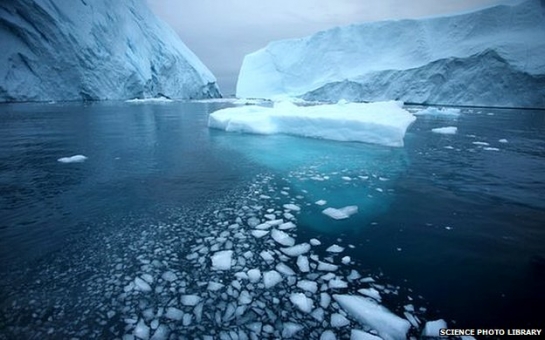


A river of ice in Greenland has become the fastest-flowing glacier currently known in the world, a study suggests.
In summer, the Jakobshavn Glacier - widely thought to have spawned the iceberg that sank the Titanic - is moving about four times faster than it was in the 1990s.
The Greenland Ice Sheet has seen record melting in recent years and would raise sea levels 6m were it all to vanish.
Details of the research are published in The Cryosphere journal.
Ian Joughin and Ben Smith of the University of Washington's Polar Science Center in Seattle analysed pictures from the German TerraSAR-X satellites to measure the speed of the glacier.
"As the glacier moves we can track changes between images to produce maps of the ice flow velocity," said Dr Joughin, the study's lead author.
In the summer of 2012, the glacier reached a record speed of more than 17km per year - more than 46m per day.
"We are now seeing summer speeds more than four times what they were in the 1990s on a glacier which at that time was believed to be one of the fastest, if not the fastest, glacier in Greenland," Ian Joughin explained.
The researchers noted that summer speeds are temporary, with the glacier flowing more slowly over the winter months.
But they added that even the annually averaged speed-up over the past couple of years is nearly three times what it was in the 1990s.
Though Jakobshavn is now believed to be the fastest flowing feature of its type in the world, Prof Jonathan Bamber, a glaciologist from the University of Bristol, told BBC News that it might not be the fastest movement ever observed because some surging glaciers can flow very quickly for short periods (on the order of months).
The increasing velocity of Jakobshavn, located in the south-west of Greenland, means that the glacier is adding more and more ice to the ocean, contributing to sea-level rise.
"We know that from 2000 to 2010 this glacier alone increased sea level by about 1mm. With the additional speed it likely will contribute a bit more than this over the next decade," said Ian Joughin.
As the Arctic region warms, Greenland glaciers have been thinning and calving (releasing) icebergs further and further inland. This means that, even though the glacier is flowing towards the coast and carrying more ice into the ocean, its calving front is actually retreating.
In 2012 and 2013, the front retreated more than a kilometre further inland than in previous summers, the scientists report in their study.
The researchers believe Jakobshavn is in an unstable state, meaning it will continue to retreat further inland in the future.
By the end of this century, its calving front could retreat as far back as the head of the fjord through which the glacier flows, about 50km upstream from where it is today.
(BBC)
ANN.Az










 Photo



 Video