





Man eating anacondas - Documentary FILM
21.12.2013 09:59


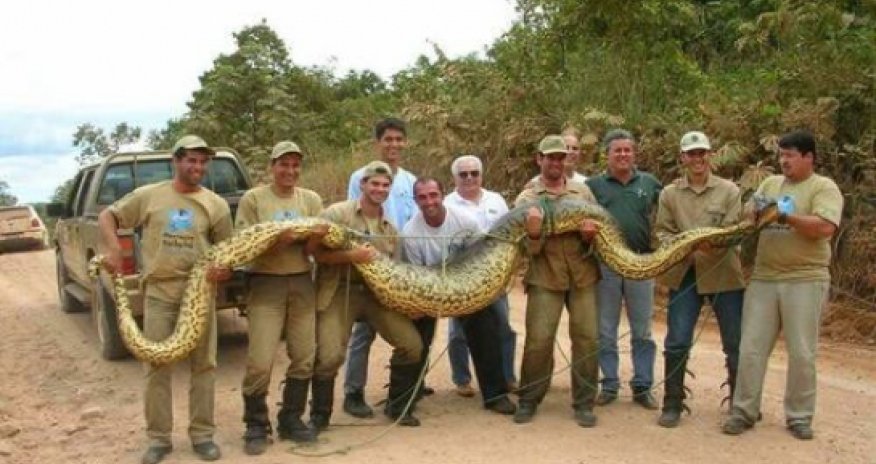
Researchers trek into the jungles of Venezuela on the search for man-eating anacondas; and later a trip to the Florida Everglades to look for massive pythons -- where one was photographed swallowing a full grown alligator. An anaconda is a large, non-venomous snake found in tropical South America. Although the name actually applies to a group of snakes, it is often used to refer only to one species in particular, the common or green anaconda, Eunectes murinus, which is one of the largest snakes in the world.Any member of the genus Eunectes, a group of large, aquatic snakes found in South AmericaEunectes murinus, the green anaconda, the largest species, is found east of the Andes in Colombia, Venezuela, the Guianas, Ecuador, Peru, Bolivia, Brazil and Trinidad and Tobago.Eunectes notaeus, the yellow anaconda, a small species, is found in eastern Bolivia, southern Brazil, Paraguay and northeastern Argentina.Eunectes deschauenseei, the darkly-spotted anaconda, is a rare species found in northeastern Brazil and coastal French Guiana.Eunectes beniensis, the Bolivian anaconda, the most recently defined species, is found in the Departments of Beni and Pando in Bolivia.The giant anaconda is a mythical snake of enormous proportions said to be found in South America.Any large snake that "constricts" its prey (see Constriction), if applied loosely, could be called anaconda.EtymologyThere are various theories regarding the origin of the name Anaconda itself, sources suggest that the name Anaconda comes from the Tamil word anaikondran, which means "elephant killer". Another suggestion is that it represents Tamil word anaikkonda which means "having killed an elephant".There are other theories that say that the word originated from the Sinhala henakandaya since the phonetic sounds are very similar. However, this name is used to refer the brown vine snake, Ahaetulla pulverulenta.The word is of uncertain origin as no snake name like it is found in Sinhalese or Tamil. It is unclear how the name originated so far from the snake's native habitat; it is likely due to its vague similarity to the large Asian pythons.The name was first used in the English language in 1768 by V. Jonasson in a colorful description of a large snake found in Ceylon (now Sri Lanka), most likely a reticulated python, Python reticulatus. The account, which explains how the snake constricts and devours tigers, is full of popular misconceptions, but was much read at the time, and so gave rise to the myth of the anaconda of CeylonANN.Az














 Photo
Photo 



 Video
Video