





These two blocks are actually the same shade of grey
11.12.2013 20:40


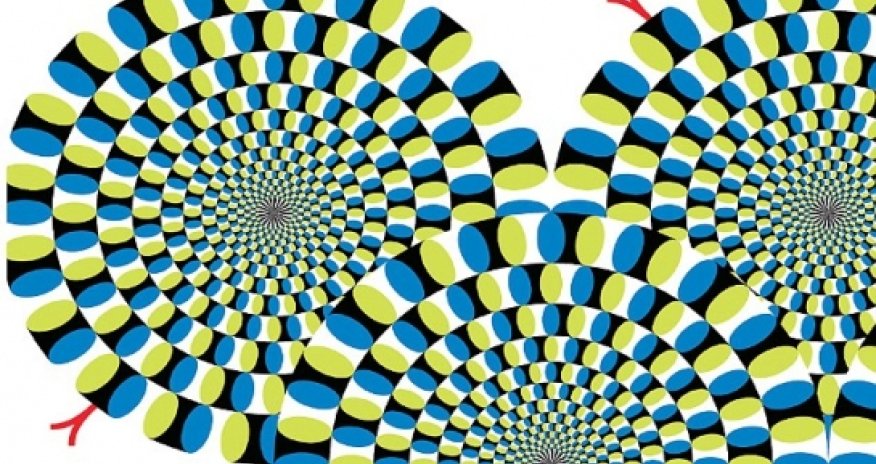
How much would you bet that these two blocks are different shades of grey? It seems obvious that they are not the same, but place one finger along the centre of the line blocking the darker and lighter parts, and your eyes will begin to tell the truth. The two blocks are, in fact, the exact same colour and only appear different due to the effect of the darker and lighter shading across the middle.This illusion was documented by experimental psychologist Tom Cornsweet in the 1960s, hence its name: the Cornsweet illusion.Cornsweet, who is best known for his work in visual perception, noted that humans perceive colour and shade of 3D images in a certain way depending on the way the item is lit and the way shadows fall.If the light is falling from the upper left and the two blocks appear tilted away from us, then we see the upper block as lit and the lower block in shadow, due to the light source coming from the upper left of the image. Combined with the contrasting shading in between the two blocks, our brain interprets the top block as dark and the bottom on as light.The scientists Purves, Lotto and Nundy write in American Scientist: '[Perception] accords not with the features of the retinal stimulus or the properties of the underlying objects, but with what the same or similar stimuli have typically signified in the past.'In other words, our eyesight is reflective - we perceive the upper square to be darker and the lower one to be lighter because that's what is logical and what our brains expect because of the other elements surrounding the grey.We think it's lit from above - but it's not. The effect is even more dramatic on the below optical illusion created by Edward Adelson from the Massachusetts Institute of Technology.The squares marked 'A' and 'B' are actually exactly the same shade of grey. Your eyes and brain are constantly trying to figure out the colour of the objects around you, and in doing so automatically compensate for shadows.The square marked 'B' is in the shadow cast by the green cylinder, while the square marked 'A' is outside of the shadow. Your eyes and brain see that the two squares are the same shade of grey.If you need more convincing that you shouldn't always believe what you see, then focus on the red cross below while the dots are moving around. You're probably seeing the dots wriggling around in different directions. But in reality they’re moving in straight trajectories without ever colliding.To convince your brain, focus on one dot without looking at the red cross and you will see it moving in a straight line.Scientists at Keio University in Japan found that if white circles on a black field are moved in straight lines and allowed to cross, they appear to move in straight lines.But if those lines avoided intersections, the dots appear to wriggle around instead.The researchers discovered that the illusion was more obvious when there were a large number of dots on the screen.‘The illusion was independent of the distance covered and the observer's eye movements as well as the dot types,’ they wrote in the Journal of Vision.Scientists in Japan also created this image of coils whic,h although they appear to be rotating, are completely stationary.The effect works best in peripheral vision, so when you stare at one of the coils it will appear stationary while those around it will appear to rotate.Vision experts aren't exactly certain why it works; however, their research has revealed that the shading of the segments that make up the rings is crucial.Another unexplained illusion is the 'grid' first first reported by German physiologist Ludimar Hermann in 1870, and simply involves a white grid on a black background.As you move your eyes around the image, dark dots quickly appear and disappear at the intersections. However, whenever you look directly on any intersection, the dark dots vanish. For years it was widely believed that the illusion worked because of 'lateral inhibition' - the term used to describe the complex way in which the cells on the back of the retina respond to areas of black and white.A few years ago this theory was shown to be completely untrue, and so the explanation for the illusion remains a mystery.Some illusions are more easily explained. For instance, the horizontal lines in this image appear to be sloping, but in reality they're parallel to one another. Although it's easy to see the mortar line between two black tiles or two white tiles, it's much harder to see the mortar line between a white tile and a black one.Your brain fills in the gap by seeing it as part of either a white or black tile. This, in turn, makes the tiles look wider at one end than at the other, creating the illusion of a series of wedge-shaped tiles, which makes the lines appear to slant.(dailymail.co.uk)ANN.Az


Youtube
Follow us on Youtube


Similar news
Similar news





Society 13:30
Students Without Final Academic Evaluation Ineligible for School Diplomas — Deputy Minister







 Photo




 Video


