



'Freezing' lawless regions invites hot conflict - OPINION

04.08.2014 19:00


By BRENDA SHAFFER
The downing of Malaysia Airlines 3786.KU +4.55% Flight MH 17 over rebel-held territory in eastern Ukraine on July 18 illustrates the dangers that ungoverned territories present to international security. A significant number of territories are currently without an accountable authority and present dangers to their neighbors and others. We need better strategies to get rid of these black holes in the international security system, or prevent them forming.
Currently lawless or unaccountable territories arose in different ways and for different reasons. Some territories, like the Gaza Strip, have been transferred to governance under nonstate entities with limited legal authority. Some ask to be recognized as states, such as the Palestinian Authority, yet do not want all the responsibilities of statehood, like limiting militia activity within their borders.In other places, due to the activity of separatists, states are unable to assert their legal sovereignty. Such areas include the Armenian-supported region of Nagorno-Karabakh in Azerbaijan, and the Russian-engineered "breakaway" territories of Abkhazia in Georgia and Transnistria in Moldova. All three are effectively ruled by a neighbor who prefers to maintain the illusion of separation in order to derive benefits without consequences.In some instances, accepting territories without legal, liable governments has become a preferred method in the international system to avoid hard choices on conflict resolution. For over 20 years since the Soviet breakup, four disputed regions—in Moldova, Azerbaijan and two in Georgia, including South Ossetia—have been left in this limbo. The U.S. and most other nations continue to formally recognize them as the legal territory of recognized states from which they broke away. But in many cases the international community simply ignores the status quo because it provides an illusion of peace.The convenience of "freezing" conflicts instead of resolving them comes at a cost. These ungoverned territories are centers of illicit activity, including money laundering, counterfeit goods, human trafficking and the drug trade. They are often havens for terrorists and criminals. Individuals inside and outside often derive financial benefit from unregulated economies in these areas, where taxation is nonexistent. Since banks in these regions may not be registered with states, no one is technically running afoul of international treaties and no one can be sued for illicit activity.It is time to ensure that each such disputed territory has a return address so that it is liable for its actions. There should be a separation between legal sovereignty and security responsibility: If a state supports a militia or force that operates in another area—like Iran's Hezbollah or Russia's client militias in Ukraine and regions of Georgia—then Tehran and Moscow are the return addresses.This distinction is important for leverage. Most of the states that support rebels in other territories are signatories to international treaties and conventions related to prevention of terror-financing, production of counterfeit goods, banking regulations, human trafficking and more. If this activity takes place in the regions run by their surrogates, the backing state is liable. Political fabrications, such as so-called independent Abkhazia or Nagorno-Karabakh or the People's Republic of Donetsk, should not be used by neighboring states to circumvent responsibility for their own actions in creating these unstable regions out of another state's land.But the rest of the international community has responsibilities too. States whose sovereignty is threatened should be supported by the international system to assert their authority throughout their territories. The U.S. and Europe in particular should not encourage states under siege to negotiate with rebels, but with their state sponsors. More broadly, the international community should not encourage the establishment of entities with limited authority in lieu of the resolution of conflicts, as happened with the Palestinian Authority.To prevent the creation of other non-governed territories, the U.S. should not contribute to state failure and then call that democratization. In Libya the U.S. has undermined state authority or weakened institutions. In Syria, U.S. and other support for rebels has unintentionally turned some Syrian regions into ungoverned territories, which has provided opportunities for the rise of the most malevolent militias.Above all, states should be held responsible for what takes place in their de jure territories. If Palestine wants a flag at the U.N., it cannot relieve itself of responsibility for what happens in its territory by claiming that nonstate militias out of their control are perpetrating attacks. And if Russia wants the respect of the international community, it must control the separatists in eastern Ukraine that it is supporting and take responsibility for the downing of Malaysia Airlines Flight 17.The U.S. and Europe should stop trying to "freeze" conflicts as a means for conflict resolution. This only delays the next round of conflict and leaves huge territories that are springboards for further danger.Ms. Shaffer is a visiting researcher and professor at Georgetown University's Center for Eurasian, Russian and East European Studies.http://online.wsj.com/articles/brenda-shaffer-freezing-lawless-regions-invites-hot-conflict-1407098343?tesla=y&mg=reno64-wsj&url=http://online.wsj.com/article/SB10001424052702304297104580051113874184130.htmlBakudaily.az


Instagram
Follow us on Instagram
Similar news
Similar news
Political News 13:30
Ombudsman to Issue Formal Statement on Journalist Assault Incidents in Coming Days
Political News 15:35
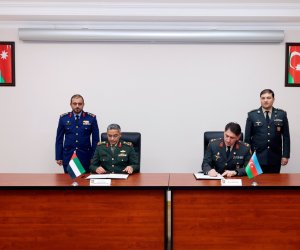
Joint Military Cooperation Committee Concludes Second Meeting, Signs 2027–2029 Strategic Roadmap
Political News 12:29
President Ilham Aliyev: Intercultural and Interreligious Relations Central to Azerbaijan’s Agenda
Political News 10:00
Ilham Aliyev: "Baseless Notions That Anyone Can Dictate to Us Will Meet Our Resolute Stance"
Political News 16:30
Netherlands to Explore Demining Support for Azerbaijan, Foreign Minister Berendsen Says



 Photo




 Video


