





Scientists holed up in tiny observatory at the edge of the world
29.05.2020 06:13


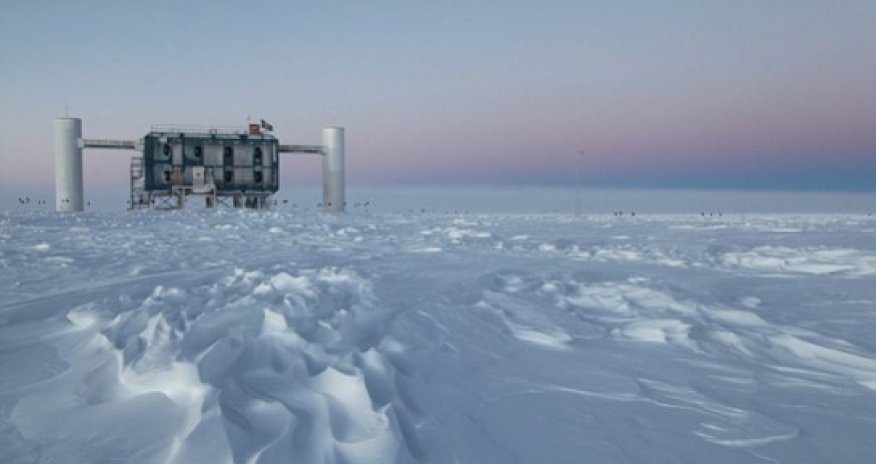
In an observatory deep in an inhospitable area of the South Pole, a group of American scientists have been holed up for the last two years, waiting with baited breath for a little sign - something to show that they were not going loopy looking for a tiny little particle that no one has ever seen.That day has finally come and the researchers have announced they have reached a new frontier in studies of the universe - a discovery they are calling a ‘new age of astronomy’.The US-led $270m IceCube facility based on a cubic kilometre of Antarctic ice has detected very high-energy cosmic neutrinos - subatomic particles that reach Earth from deep space, possibly the remnants from exploding stars, called supernovae.Ordinary telescopes cannot see the elusive neutrinos, but IceCube's can. It is the largest neutrino telescope in the world.Unlike photons, aka light particles, they hardly ever interact with ordinary matter, because they carry no electric charge and very little mass. This makes them extremely hard to detect. The IceCube facility, however, can see neutrinos, which stream across the universe in unimaginable quantities, according to FT.What makes neutrinos so important to astronomers’ probes is that they travel in absolutely straight lines from their source without being deflected by magnetic fields or absorbed by matter. They escape more readily than photons from the core of a supernova, for example, or other such phenomena in the universe.Neutrinos have already been detected in various forms. The first was 'seen' in 1956. However, scientists had not yet detected the pure form of neutrinos that are at least one million times more energetic than those already detected.These are the ones produced from turbulent gaseous environments left over by supernova explosions, also known as the supernova remnants.The IceCube was built in the South Pole to maximise the chance of observing these elusive cosmic neutrinos.Rearchers melted holes in the ice cap and lowered 5,160 light detectors to depths of between 1,500m and 2,000m beneath the surface.Neutrino detectors are often built underground in order to isolate the detector from cosmic rays and other background radiation.Although trillions of neutrinos travel unscathed through the observatory every second, a precious few arrive at exactly the right angle to hit an atom in the ice. This collision generates electrically charged particles which radiate light that is picked up by the detectors. Computers then calculate the energy and incoming direction of the neutrino from the pattern and intensity of the light emitted.The IceCube team last week said in the journal Science they had detected 28 high-energy neutrinos coming from beyond the solar system over two years. Lower-energy neutrinos reach us in vast numbers from the sun and also from the interaction between cosmic rays and Earth’s upper atmosphere.These 28 neutrinos are too small a sample to derive any conclusions about what produced them, but whatever it is must generate staggeringly high energies. Two of the detected neutrinos had more energy than a fly in flight, packed into a single subatomic particle.Likely sources include supernovae and material being sucked into huge black holes.‘It is gratifying to finally see what we have been looking for,’ says Francis Halzen of the University of Wisconsin and IceCube principal investigator. ‘This is the dawn of a new age of astronomy.’ The IceCube project is part of the University of Wisconsin–Madison projects developed and supervised by the same institution, while collaboration and funding is provided by numerous other universities and research institutions worldwide.(dailymail.co.uk)ANN.Az


Similar news
Similar news












 Photo
Photo 



 Video
Video