





Russian plane crash: Waiting for that 0.1%
16.11.2015 12:30


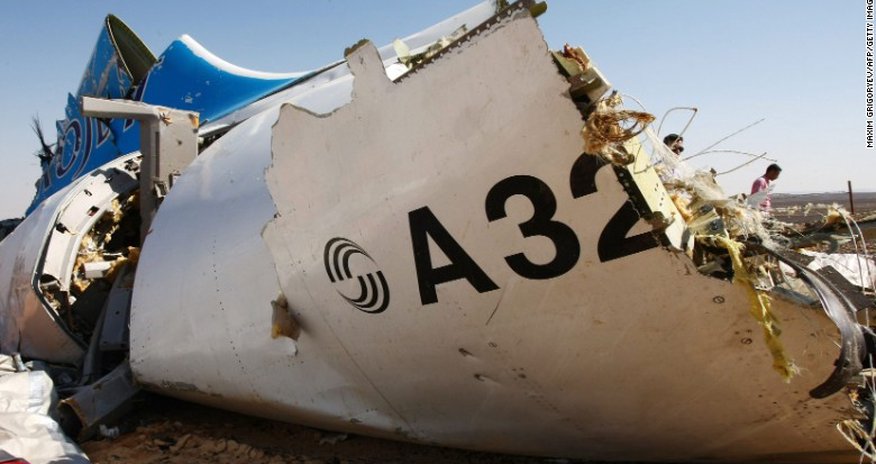
More than a week after the flight from Sharm el-Sheikh to St. Petersburg exploded in the air, killing all 224 on board, there is a growing consensus by U.S. and British officials that the Russian Metrojet Airbus A321 was downed by a bomb placed by affiliates of ISIS. One intelligence official said it was "99.9% certain" that a bomb downed the plane.
Adam Schiff, the leading Democrat on the House Intelligence Committee, had a similar just-about-there statement Saturday: "I think there's a growing body of intelligence and evidence that this was a bomb -- still not conclusive -- but a growing body of evidence."
Why the reluctance to go that final 0.1%?
Why did British Prime Minister David Cameron go from "more likely than not" mid-week in such an aggressive way that he seemed more American than British, only to recede by week's end, tempered by U.S. President Barack Obama's line that a bomb was just a possibility?
The explanation may reside in the intelligence wars between enemies and allies. Animating the drama of the tragedy itself is something much more covert and, in many ways, cuts to the core of any wartime strategy: Winning the battle isn't the same as winning the war.
We know now from numerous reports that Western intelligence officials picked up post-crash "chatter" by ISIS that it was responsible for the flight explosion. In most instances, such boasting means almost nothing standing alone.
ISIS, just like al Qaeda, will take responsibility for hurricanes and earthquakes if it can. Its major recruitment tool is, after all, looking like it is both tough and successful. Nothing says "we're winning" for ISIS than a victory lap over the bodies of innocent civilians.
But this chatter seemed different, different enough for nations to act on it without actually concluding -- with certainty -- that a terrorist attack had indeed occurred.
Today, the fight against ISIS will be long-term, involving multiple countries with a common strategic interest in defeating the terrorist organization. Each country -- in particular the U.S., Britain, Russia and Israel -- will also have its own interests in strong intelligence efforts in countries as politically far-ranging as Yemen, Jordan, Syria and Egypt.
And each will use its own sources and methods to infiltrate the group, garner information and track communications all in the hopes of defeating the enemy. The only way it works, though, is if the enemy doesn't know how it's being followed.
The result: a lot of equivocating, followed by near certainty. No leader wanted to disclose that the post-crash chatter was picked up, how it was collected, and what sources and methods were used -- including possibly human assets -- to get the information. The airplane blowing up is only a single battle; the war continues. And to fight the war, ISIS cannot know the extent to which it is being followed.
This is a real tension in the intelligence wars and why physical proof is so much less complicated than all this James Bond stuff. Simply put, with no definitive physical evidence proving a bomb, and (for now) inconclusive noise from transcripts of the plane's "black boxes," the chatter is the basis of all this near certainty.
And now that it knows that these signals were picked up, the terrorist organization has invaluable knowledge about Western efforts against it. ISIS is sophisticated enough to have now closed off those communications networks, which may have taken anti-ISIS intelligence agencies years to penetrate.
(CNN)
www.ann.az


Twitter
Follow us on Twitter










 Photo




 Video


