

Syria peace talks and polls signal Assad's growing confidence
14.04.2016 00:02


Syrian President Bashar al-Assad's negotiating team is in no hurry to return to the Geneva peace talks, which resume this week. Delay suits them.
The partial truce brokered by the US and Russia is under strain, and the Syrian military has announced a campaign to "liberate" Aleppo with the backing of Russian air strikes, a move which, if successful, may encourage President Assad to declare a major victory against the struggling opposition.
Bashar al-Jaafari, the government's head negotiator, has already announced his team will arrive in Geneva late.
Wednesday's Syrian parliamentary elections, announced at short notice just weeks ago, have to be completed first. Then Mr Jaafari is scheduled to give a keynote speech in New Jersey to commemorate the 70th anniversary of Syria's full independence from French rule.
The message to the international community is clear: the Assad regime is the only legitimate government of Syria.
Image boost
The propaganda value to President Assad of the recent recapture of Palmyra from so-called Islamic State (IS) in championing this message has been key.
Foreign journalists, normally denied visas, were suddenly invited in and bussed across the desert to photograph the fabulous ancient ruins, still 80% intact, that lie between Syria's largest oasis and an extinct volcano - the perfect romantic backdrop to what Mr Assad hopes will be his rehabilitation as national hero valiantly fighting IS terrorism.
Palmyra was the crown jewel in Syria's tourism industry and its restoration will now be the flagship project for rebuilding Syria.
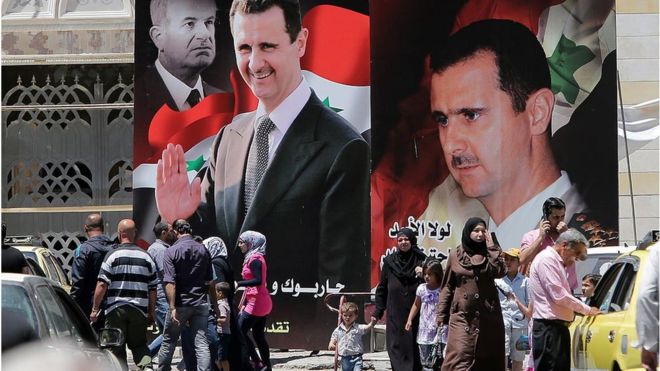
Election slogans on the placards all over Damascus echo the mantra "Together, hand in hand, we will rebuild Syria", "Victorious Syria votes".
President Assad himself is never mentioned, just Syria, its glory and its martyrs, though he has commented how the startling 12,000 candidates for the 250 seats prove the vote is not a sham.
Both Russian and Iranian parliamentarians have been in Damascus to support the vote and declare their readiness to be "a real partner to their Syrian counterparts in the post-crisis reconstruction stage".
The Russian delegation said it "sensed the obvious competition among all candidates."
Empty exercise
But on the international stage no-one except Russia and Iran recognises these elections.
The outcome is a foregone conclusion since candidates are carefully screened and selected by the security authorities and Syria's penal code makes it illegal to issue public statements that "weaken national sentiment".
As at the last parliamentary elections, which I experienced first-hand in Damascus in 2012, most voters neither know nor care about the candidates - the Syrian parliament is largely impotent.
Only government-controlled areas can take part, where the population has shrunk to around eight million from the country's pre-war total of 24.5 million.
Other Syrians have either fled the country, live in Kurdish, opposition or IS-held areas or been killed in the fighting.
Government employees are obliged to vote or risk losing their jobs.
The opposition in exile and even the officially tolerated domestic opposition have called for a boycott of the vote, seeing it as a trick to gain leverage in the peace talks.
The Democratic Unity Party (PYD), the largest Syrian Kurdish grouping, which is busy consolidating three semi-autonomous "cantons" in the north, has also said it will not allow voting in the territory it controls.
So far the PYD has not been invited to the Geneva talks, for fear of upsetting the main opposition umbrella group at the talks and its chief backers, Turkey and Saudi Arabia.
Veneer of unity
The UN's special envoy, Staffan de Mistura, is putting a brave face on all such complications, stressing that the peace talks are "flexible".
His optimistic aim is to achieve UN-supervised elections within 18 months, where all Syrians can vote, even the diaspora, be they penniless refugees or wealthy businessmen.
businessmen.But the last thing President Assad wants is independently monitored elections in which Syrians can freely choose their representatives.
His skilful negotiating team, whenever it arrives in Geneva, will ensure that goal stays tantalisingly out of reach, whilst appearing to offer national unity and reconciliation.
(BBC)
www.ann.az


Youtube
Follow us on Youtube


Similar news
Similar news




 Photo
 Video