





Indonesia's best - and goriest - cuisine
21.04.2016 12:30


While it's the unusual ingredients – from python to dog – that make Minahasa food notorious, it's the exceptional spice pastes that have built its reputation.
The dog's singed carcass lay rigid – jaws locked open, muzzle high, all four legs protruding skywards. Across the market, a butcher bisected another canine corpse, beheaded it and jointed it for sale. Below the table holding the dead body, live cats slunk and mewled, while dogs so scrawny as to be bereft of nutritional value lay curled in a hopeless doze.
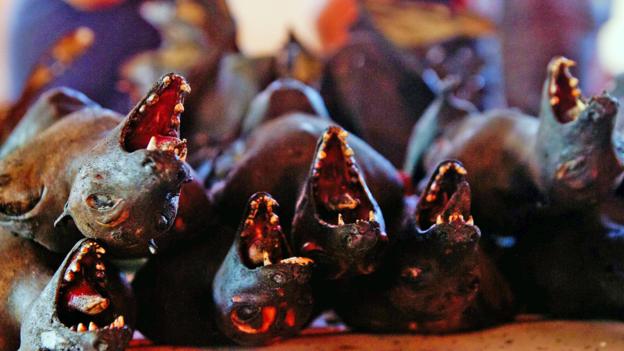
It was a typically Saturday morning in the Minahasa meat section of Indonesia’s busy Tomohon Market, located in the volcanic highlands of North Sulawesi. Bats, neatly separated from their wings, gaped in a silent, toothy scream; a python spilled its strangely pallid guts; bush rats impaled on sticks lay piled up like kebabs. An iron-heavy, slightly faecal smell filled the air. Dressed in jeans and T-shirts, football shorts and fake Lacoste, blouses, the shoppers looked indistinguishable from any other Indonesian market crowd. But almost all were Minahasa people, famous for their bizarre – yet delicious – cuisine.
Although they left the forest centuries ago, Minahasa people still eat many of the same meats that their highland forerunners did 6,000 years earlier, including wild boar, snake and bat. "At Easter, there will be monkeys and turtles in the market,” said expedition leader Michael Leitzinger, who runs the nearby Highland Resort & Spa. "They eat them for a treat just as we might have turkey for Christmas.”
Today's Minahasa people are overwhelmingly Christian. During the 19th Century, the Dutch colonial government worked to eliminate all forms of Minahasa ritual, from headhunting and sacrifice to multi-family houses and sarcophagus burials. Protestant missionaries pushed Christian doctrine so effectively that in 1857, 10,000 Minahasa converted in a single day.
Even with the conversion, though, statues of tonaas – historic leaders with magical powers – are as common as churches in the town of Tomohon. And in the Woloan district just outside of town, cigarettes and cups of cap tikus, a local moonshine distilled from palm sap, rest below a sacred tree near the ruins of an ancient stone sarcophagus. They are offerings to the ancestral spirit that inhabits it.
Blood magic has been banned from the sacred megalith of Watu Pinawetengan on the slopes of the nearby Soputan volcano, apparently because the caretaker objected to cleaning up the gore. But Minahasa black magicians still make animal sacrifices at a secret cave each full moon.
"It's usually a white chicken for white magic, but can be black or white for other types of magic,” explained Veronica, a local magician.
Veronica is Catholic, and like almost all Minahasa, has a Christian name, but she sees no contradiction between her faith and her magic practice, believing that saints are just another name for spirits. For her, both magic and the habit of eating ancient forest foods are signs of an unusually resilient culture. "Minahasa culture is a very strong culture,” she said. "No matter how modern the world is, they will stick to the old ways.”
And, indeed, strict rules govern the Minahasa menu. "We don't eat dogs from our hometown,” said Adam Pongoh, my Minahasa guide. As such, the dog catchers who round up animals from other towns at night are widely resented elsewhere in Indonesia.
When Pongoh's father, Junus, started selling spices at the Tomohon Market more than 35 years ago, both the endangered tarsier (a tiny, bug-eyed primate) and the endangered kuskus (a nocturnal marsupial that's unique to the Sulawesi region) were regularly on sale. Following a government clampdown a few years back, it's mercifully hard to find threatened species nowadays.
Most exotic meats in the Tomohon Market are delicacies to be cooked at home as a special treat rather than served in restaurants. Python, Pongoh said, was becoming increasingly rare: "It tastes like chicken, and we use the same spices, but chicken is half the price.”
I had previously tried dog, cooked Minahasa style with galangal, chilli, garlic, shallots and more, and found it delicious – but very hard to eat. (Traditional Minahasa cooking has little regard for bones, and I personally found it challenging to scrape dog meat off the bone with my teeth.) So when Pongoh brought me to the Puncak EG restaurant (Jalan Dosen, Kuranga village, Tomohon), I was relieved to find that dog was already finished for the day. Bat, however, was not. Chopped into tiny chunks, complete with fatty, rubbery black skin, it looked astonishingly unappetising. But the combination of gamey meat and pine-scented, tangy coconut curry was highly palatable.
Python, later, was cooked in a delicious rica-rica sauce, heavy with chilli and lemon basil. The meat tasted fine – indeed, not far from chicken breast – but had too many small bones, while the patterned, slightly fatty skin was well outside my comfort zone.
Indeed, while it's the unusual ingredients that make Minahasa food notorious, it's the spice pastes, made from recipes handed down the generations, which have built its reputation. All Minahasa sauces start from a basic spice paste: chilli, salt, garlic, ginger, turmeric and candlenuts, pounded with an ultra-long pestle. Some, like the delicious babi daun leilem (pork with leilem leaves) gain their unique flavour from leaves only found in the Minahasa region, where plants are so atypical that Tomohon University has an herbal medicine department researching traditional uses. But others can and have travelled.Chefs from Bali to Amsterdam are discovering the magic of woku, a tangy sauce with lime, kaffir lime leaves, lemongrass, spring onions and lemon basil, used for fish and chicken. Rica-rica, with kaffir lime leaves, lemongrass, lemon basil and lashings of chilli, is so delicious that it has spread, albeit often missing key ingredients, across the Indonesian archipelago.
And, of course, at Indonesia's specialist dog-meat eateries – identified by the euphemism "RW” - there will always be a Minahasa dish on the menu.
(BBC)


www.ann.az


Instagram
Follow us on Instagram
Similar news
Similar news











 Photo



 Video