


Hundred days of Myanmar's democracy
08.07.2016 11:30


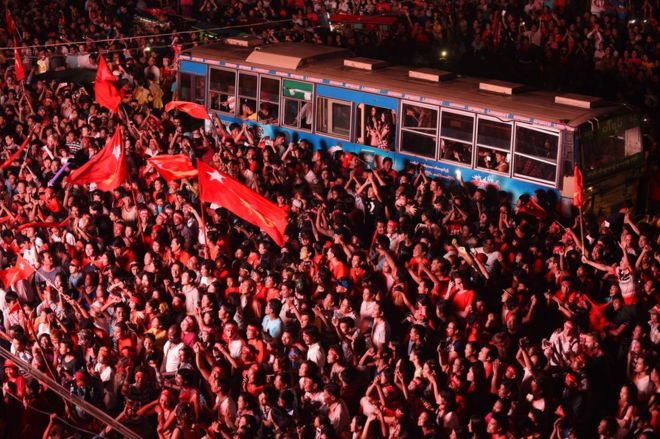
It's been 100 days since Myanmar's first civilian government in more than 50 years took office. Making the transition away from military rule was never going to be simple, but new policies and priorities are emerging. So what does the future hold?
The BBC's Myanmar correspondent Jonah Fisher picks out some of the key themes from the first three months.
Being president no longer matters
For so long the debate over 59F, the constitutional clause that bars Aung San Suu Kyi from becoming president, was central to discussions about Myanmar. Not any more. By installing Htin Kyaw, a trusted friend in the top job, and creating the new position of State Counsellor for herself Ms Suu Kyi is now more powerful than if she had simply been president.
Constitutional change has slipped quietly away
During last year's election campaign changing the constitution to reduce the political power of the Burmese army was one of Ms Suu Kyi's key pledges. Now it's hardly mentioned. She appears to have accepted that the constitution is a "red line" for the army that could threaten her government's survival.
Ms Suu Kyi's aides now parrot the long-stated army position that this issue can only be addressed when there is a stable peace agreement with the country's many armed groups.
Peace really is the priority
This is the holy grail of Burmese politics. Myanmar has been blighted by simmering conflicts along its borders ever since independence from Britain.
Aung San Suu Kyi is trying to re-invigorate the stalled peace process that the previous president, Thein Sein, left behind. Central to that is an all-inclusive summit that's due to start at the end of August.
Called "The 21st Century Panglong Conference" , it hopes to draw inspiration from the Panglong Agreement of 1947, that her father signed with three ethnic groups.
Though Ms Suu Kyi brings fresh energy, this will be infinitely more complex, with as many as 15 different armed groups taking part. Getting them to agree amongst themselves is the first challenge. They may also find Ms Suu Kyi a surprisingly tough negotiator.
So ethnic fighting continues
While talks about talks take place, the Burmese army has continued fighting armed groups in three states.
With the military beyond the control of Myanmar's elected leaders, a change in government has made little difference on the battlefield. There's been no sign that the army's abuse of villagers has stopped, and the armed groups are hardly saints..
No 'quick fix' for the Rohingya
Conditions are still miserable for the 100,000 or so Rohingya in camps, and not much better for the several hundred thousand who live restricted lives elsewhere in Rakhine State.
To date Ms Suu Kyi has formed a committee but offered no long-term solution for a stateless group of people who are still being denied basic human rights.
Terminology remains a constant distraction. Ms Suu Kyi has tried to take the steam out of the issue by asking people to stop using the polarising words "Rohingya" and "Bengali" and instead say the "Muslim Community in Rakhine State". It's a solution that has angered both Muslim and Buddhist communities but there are signs that some diplomats may comply.
A revolving door for political prisoners
A former detainee herself, Aung San Suu Kyi promised to release all political prisoners, and dozens have been set free since March.
The problem is that Myanmar's repressive laws are still putting people behind bars. To its credit, the Burmese parliament has started changing some of the worst laws, but this will take time.
Suu Kyi remains reluctant to speak up for Muslims
Is Ms Suu Kyi anti-Muslim? Her party didn't field any Muslim candidates in last year's election and at the time her officials explained it as necessary pragmatism to avoid upsetting hard-line Buddhist monks.
Now in power with an overwhelming electoral mandate there is room for manoeuvre. Ms Suu Kyi has reached out to other groups like, for example, making a Christian from an ethnic minority vice president, but many Muslims, who make up at least 5% of the population feel excluded.
In recent weeks there have been anti-Muslim protests in Rakhine state and Muslim-owned buildings have been destroyed by mobs. Ms Suu Kyi has said very little.
Not for the first time when confronted with the most sensitive of issues the Nobel laureate has chosen to keep her head down, rather take a stand.
(BBC)
www.ann.az


Youtube
Follow us on Youtube


Similar news
Similar news








 Photo


 Video