




How the Navy avoids norovirus
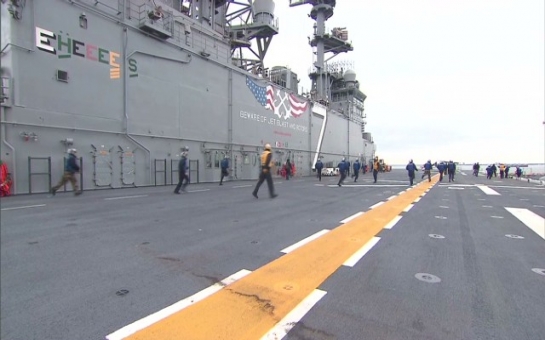


Nearly 700 crew and passengers onboard Royal Caribbean's Explorer of the Seas were sickened by norovirus in January before the ship returned to its port in Bayonne, New Jersey.In addition, the Caribbean Princess, operated by Princess Cruises, cut a seven-day itinerary short the same week because of a norovirus outbreak that affected 178 passengers and 11 crew members.In the Navy, such an outbreak would cripple a ship."If we had a norovirus that took out 700 sailors, we obviously would be operationally ineffective, combat ineffective -- but even a smaller number, a smaller outbreak of, say, 100 would devastate our operational capability," Capt. Jim McGovern, commanding officer on the USS Iwo Jima, said aboard his ship docked in Norfolk, Virginia. "Serious outbreaks of 10 or 20 individuals being sick are taken very seriously."Some 3,200 sailors and marines fill the amphibious assault ship when it deploys, and each of them are medically screened and inoculated before being allowed to embark."The idea is to prevent somebody from getting ill. Once you do become ill from one of these highly contagious organisms, you are really chasing it then," Vice Adm. Matthew Nathan, Surgeon General of the Navy, told CNN."One person touches something, then three people touch that and they become infected, then three people from them, and pretty soon you've gone from 1 to 3 to 9 to 27 and that is how a cruise ship, in short order, has 700 people come down."What is norovirus?Onboard a warship like the Iwo Jima, sailors are required to report to sickbay if they feel unwell."They come to us for sick call, and if they are particularly stoic and don't want to come to us for whatever reason, their supervisor will make them come," said Sean Sullivan, the vessel's senior medical officer.If a sailor does become ill with a contagious disease, they will be isolated so the infection does not spread."You monitor the movements of everybody who is ill. You make sure they are staying away from the general population on the ship. They are not to go to their work station, they are not to go to the food places," Nathan said.Keeping vessels extraordinarily clean is part of the daily routine for everyone onboard U.S. Navy ships."Every day at 0730 we basically do a cleaning station of the ship. Every department has their own space," sailor John Canevari said, clearly showing pride in his section of the passageway."We live here. If we want to go out on deployment for eight or nine months, we need to make sure it's clean."In the kitchens, cleaning is constant to prevent foodborne illnesses."It's important to keep it clean because cross-contamination is a big factor for illnesses," said Jakeila Owens, Iwo Jima culinary specialist.Just in case crews in the galleys miss something, preventive medicine technicians like Aaron Ferguson inspect multiple times every day.They are "making sure their hands are clean, uniforms are clean, they have hairnets on properly, making sure their lines are clean, so there is not dirt buildup or anything like that which could get people sick," he said.Is your cruise safe?The rigorous discipline and devotion to cleaning is aided by simply not having certain creature comforts, such as those cruise ship passengers expect."If you have a ship whose main center of gravity is social gatherings, food places, dancing areas places for libations, and gating on decks and swimming pools -- all of those things that sailors wish they had, but don't have on our Navy ships -- then I think it is a much more challenging environment to control the spread of a highly contagious virus," Nathan said.McGovern experienced an outbreak firsthand, years before taking command of the Iwo Jima. Half of the 30 people onboard his small ship fell ill."Somebody didn't have clean hands, (didn't) wash their hands properly and stuck their hand in an ice dispenser and anybody who got ice from that dispenser got sick," he said.That's why he, and sailors across the Navy, swab, inspect, scrub and scour every day.(CNN)ANN.Az













 Photo




 Video