





Old bone dates human hand evolution
29.05.2020 10:28


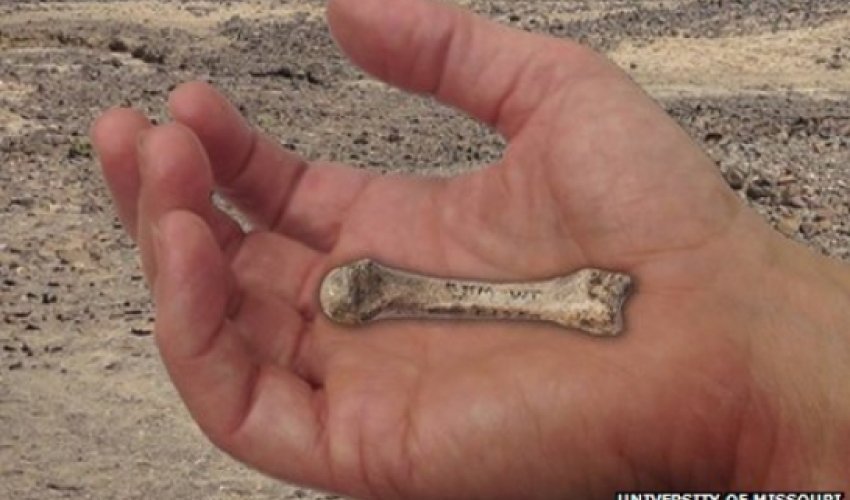
The discovery of an ancient bone at a burial site in Kenya puts the origin of human hand dexterity more than half a million years earlier than previously thought, BBC reported.In all ways, the bone - a well-preserved metacarpal that connects to the index finger - resembles that of modern man, PNAS journal reports.It is the earliest fossilised evidence of when humans developed a strong enough grip to start using tools.Apes lack the same anatomical features.The 1.42 million-year-old metacarpal from an ancient hominin displays a styloid process, a distinctively human morphological feature associated with enhanced hand function.Its discovery provides evidence for the evolution of the modern human hand more than 600,000 years earlier than previously documented and probably in the times of the genus Homo erectussensu lato.The styloid process helps the hand bone lock into the wrist bones, allowing for greater amounts of pressure to be applied to the wrist and hand from a grasping thumb and fingers.Prof Carol Ward and her colleagues note that a lack of the styloid process created challenges for apes and earlier humans when they attempted to make and use tools.This lack of a styloid process may have increased the chances of having arthritis earlier.Prof Ward, professor of pathology and anatomical sciences at the University of Missouri, Columbia, said: "The styloid process reflects an increased dexterity that allowed early human species to use powerful yet precise grips when manipulating objects."This was something that their predecessors couldn't do as well due to the lack of this styloid process and its associated anatomy."With this discovery, we are closing the gap on the evolutionary history of the human hand. This may not be the first appearance of the modern human hand, but we believe that it is close to the origin, given that we do not see this anatomy in any human fossils older than 1.8 million years."Our specialised, dexterous hands have been with us for most of the evolutionary history of our genus, Homo. They are - and have been for almost 1.5 million years - fundamental to our survival," she said.The bone was found at the Kaitio site in West Turkana, near an area where the earliest Acheulian tools have appeared. Acheulian tools are ancient, shaped stone tools that include stone hand axes more than 1.6 million years old. ANN.Az














 Photo
Photo 



 Video
Video