





Why are so many animals dying?
15.01.2015 23:59


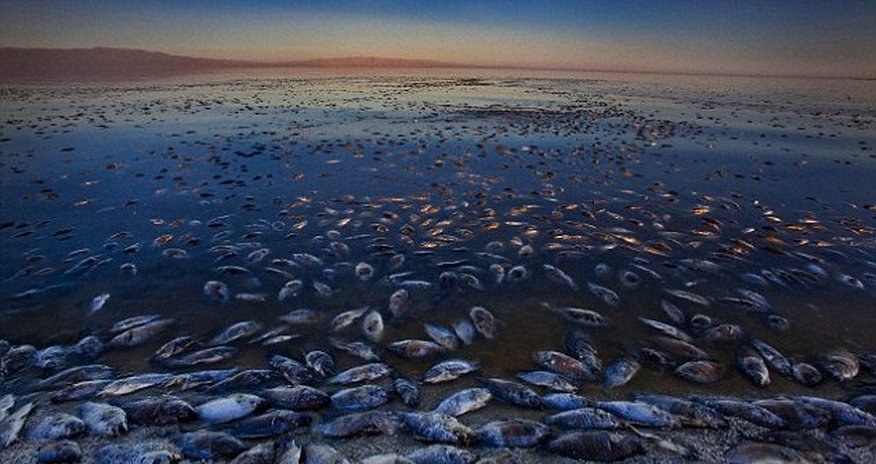
Mass die-offs of certain animals has increased in frequency every year for seven decades, according to a new study.
Researchers found that such events, which can kill more than 90 per cent of a population, are increasing among birds, fish and marine invertebrates.
The reasons for the die-offs are diverse, with effects tied to humans such as environmental contamination accounting for about a fifth of them.
The research was carried out by three US institutions - the University of San Diego, Yale University and the University of California, Berkeley - and published in the Proceedings of the National Academy of Sciences.
Mass mortality events occur when a large percentage of a population dies in a short time frame.
While they are rare and fall sort of an extinction, they still pack a devastating punch.
'This is the first attempt to quantify patterns in the frequency, magnitude and cause of such mass kill events,' said study senior author Dr Stephanie Carlson, an associate professor at UC Berkeley's Department of Environmental Science, Policy and Management.
The researchers reviewed incidents of mass kills documented in scientific literature.
Although they came across some sporadic studies dating back to the 1800s, the analysis focused on the period from 1940 to the present.
The researchers acknowledged that some of their findings may be due to an increase in the reporting of mass die-offs in recent decades.
But they noted that even after accounting for some of this reporting bias, there was still an increase in mass die-offs for certain animals.
Overall, disease was the primary culprit, accounting for 26 per cent of the mass die-offs. Direct effects tied to humans, such as environmental contamination, caused 19 percent of the mass kills.
Biotoxicity triggered by events such as algae blooms accounted for a significant proportion of deaths, and processes directly influenced by climate - including weather extremes, thermal stress, oxygen stress or starvation - collectively contributed to about 25 percent of mass mortality events.
The most severe events were those with multiple causes, the study found.
Dr Carlson, a fish ecologist, and her UC Berkeley graduate students had observed such die-offs in their studies of fish in California streams and estuaries, originally piquing their interest in the topic.
'The catastrophic nature of sudden, mass die-offs of animal populations inherently captures human attention,' said Dr Carlson.
'In our studies, we have come across mass kills of federal fish species during the summer drought season as small streams dry up.
'The majority of studies we reviewed were of fish. When oxygen levels are depressed in the water column, the impact can affect a variety of species.'
The study found that the number of mass mortality events has been increasing by about one event per year over the 70 years the study covered.
'While this might not seem like much, one additional mass mortality event per year over 70 years translates into a considerable increase in the number of these events being reported each year,' said study co-lead author Dr Adam Siepielski, an assistant professor of biology at the University of San Diego.
'Going from one event to 70 each year is a substantial increase, especially given the increased magnitudes of mass mortality events for some of these organisms.'
This study suggests that in addition to monitoring physical changes such as changes in temperature and precipitation patterns, it is important to document the biological response to regional and global environmental change.
The researchers highlighted ways to improve documentation of such events in the future, including the possible use of citizen science to record mass mortality events in real time.
'The initial patterns are a bit surprising, in terms of the documented changes to frequencies of occurrences, magnitudes of each event and the causes of mass mortality,' said study co-lead author Dr Samuel Fey, a postdoctoral fellow in ecology and evolutionary biology at Yale.
'Yet these data show that we have a lot of room to improve how we document and study these types of rare events.'
(dailymail.co.uk)
ANN.Az


Facebook
Follow us on Facebook













 Photo




 Video


