





A REAL monster of the deep!
24.06.2015 21:30


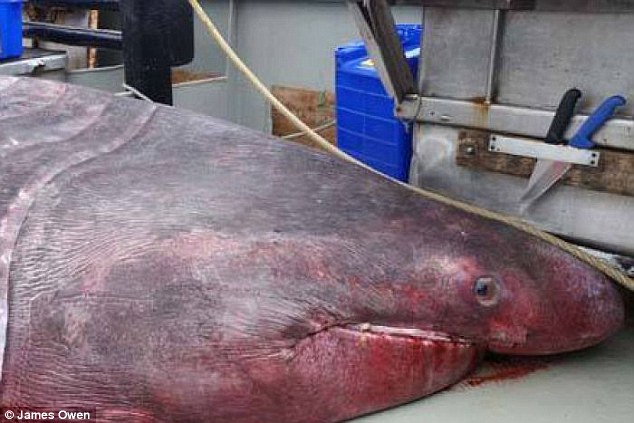
The uncommon discovery of a peculiar-looking shark is the first sighting of the second largest living fish in Australian waters for 85 years.
James Owen and his crew accidentally caught the 6.3-metre basking shark in their trawler at Portland, west of Warrnambool, in Victoria on Sunday but instead of selling the sought-after Chinese delicacy, they decided to donate the rare three-tonne male fish to science.
Only smaller than the whale shark, the mammoth fish has an unusual pink/purple hue to its skin and a huge flat nose.
The last recording of this species being captured was in the 1930s by a skipper at Lakes Entrance in eastern Victoria.
Dr Martin Gomon praised the fisherman for contacting the Melbourne Museum saying he had great respect for him
'Basking shark fins would be highly sought because they're very big,' Dr Gomon told News Corp.
'This basking shark's pectoral fins were probably over a metre in length and 60cm or more wide, and there were two of those. Its cuttle fin probably spans 1 metre to 1.2 metres. There are other fins, too: the pelvic fins.'
Dr Gomon said, along with another scientist, he had to use a crane to lift the mammoth fish out of the boat and then it took an astounding five hours to cut the shark into pieces so they were manageable to be carried.
Museum Victoria senior collections manager Dianne Bray said the museum has gill arches from the shark in the 1930s which was the only time that century.
Prior to that the species was caught in 1883 in Portland, southwest Victoria, and the museum has preserved some skin and teeth from the fish.
Ms Bray said the discovery of the fish which can grow to 12 metres long will unearth new research about the rare species.
'We'll bring some vertebrae back because we've got scientists interested in doing some ageing studies to find out how old it is,' she told the ABC.
'We'll take skin samples for DNA work, and also some muscle tissue for stable isotope analysis, so that people can look at studies of what these things are actually eating.
She said researchers are keen to track the shark's movements as there is little known about the rare fish.
'One shark's probably not going to tell us everything about what's going on down there, but the more information we have from specimens, the bigger picture we can build up about their life history and what they're doing,' she said.
'One of the ideas we have, if it's in good condition, is to make a cast of the fins and the head so we can make a model of a basking shark.'
The plankton-eating sharks, which are thought to live a solitary life, got their name because they often spend time near the surface of the water basking in the sun.
(dailymail.co.uk)


www.ann.az


Youtube
Follow us on Youtube


Similar news
Similar news











 Photo




 Video