



Human life could be wiped out on March 16 - VIDEO
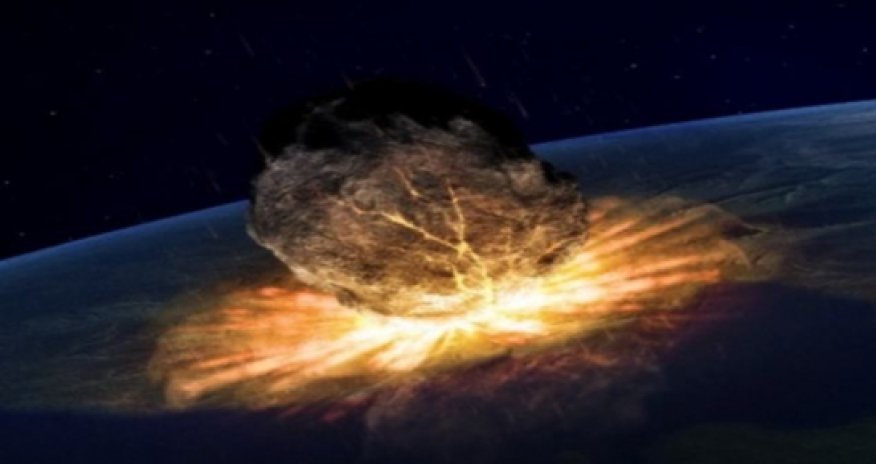


Researchers studying the rock found that its body rotates so quickly that it should break apart, but somehow remains intact on its Earth-bound trajectory. They believe it is held together by cohesive forces known as van der Waals - and although this is considered a major breakthrough, scientists still don't know how to stop it. The discovery was made by researchers at the University of Tennessee (UT), Knoxville.Previous research has shown that asteroids are loose piles of rubble held together by gravity and friction.However, the UT team found that the asteroid, called 1950 DA, is spinning so quickly that it defies these forces. It is approximately 3,280ft (1,000 metres) in diameter, but rotates once every two hours and six minutes.At this rate, the rock should break apart and eventually disintegrate, but it is not showing any signs of doing so. Ben Rozitis, a postdoctoral researcher; Eric MacLennan, a doctoral candidate; and Joshua Emery, an assistant professor in the Department of Earth and Planetary Sciences, wanted to know what keeps the body from breaking apart.By calculating 1950 DA’s temperature and density, the team detected the cohesive forces that stop it breaking up.'We found that 1950 DA is rotating faster than the breakup limit for its density,' said Rozitis. 'So if just gravity were holding this rubble pile together, as is generally assumed, it would fly apart. Therefore, interparticle cohesive forces must be holding it together.'In fact, the rotation is so fast that at its equator, 1950 DA effectively experiences negative gravity. If an astronaut were to attempt to stand on this surface, they would would be flung off into space.The presence of cohesive forces has been predicted in small asteroids, but definitive evidence has never been seen before.The findings, published in this week's edition of the science journal Nature, have potential implications for defending our planet from a massive asteroid impact.'Following the February 2013 asteroid impact in Chelyabinsk, Russia, there is renewed interest in figuring out how to deal with the potential hazard of an asteroid impact,' said Professor Rozitis.For example, this technique could get in the way of forces keeping the asteroid together, causing it to break apart into lots of smaller, threatening asteroids that could be on a collision course for Earth.This may be what occurred with the asteroid P/2013 R3, which was caught by the Hubble Space Telescope in 2013 and 2014 coming undone, possibly due to a collision with a meteor.'With such tenuous cohesive forces holding one of these asteroids together, a very small impulse may result in a complete disruption,' said Professor Rozitis.The asteroid is travelling at about 9 miles (15km) a second relative to the Earth.It is due to swing so close to Earth it could slam into the Atlantic Ocean at 38,000 miles per hour. It is estimated that if 1950 DA were to collide with the planet, it would do so with a force of around 44,800 megatonnes of TNT.Although the probability of an impact is only 0.3 per cent, this represents a risk 50 per cent greater than an impact from all other asteroids.Over the long timescales of Earth's history, asteroids this size and larger have periodically hammered the planet.The so-called K/T impact, for instance, ended the age of the dinosaurs 65 million years ago.Asteroid 1950 DA was discovered on 23 February 1950. It was observed for 17 days and then faded from view for half a century.Then, an object discovered on 31 December 2000 was recognised as being the long-lost 1950 DA.The New Year's Eve sighting was exactly 200 years to the night after the discovery of the first asteroid, Ceres.It was found that the asteroid 1950 DA has a trajectory that for a 20-minute window on March 16, 2880, a collision cannot be entirely ruled out.(dailymail.co.uk)Bakudaily.Az










 Photo
Photo 



 Video
Video