Inside Facebook - PHOTO
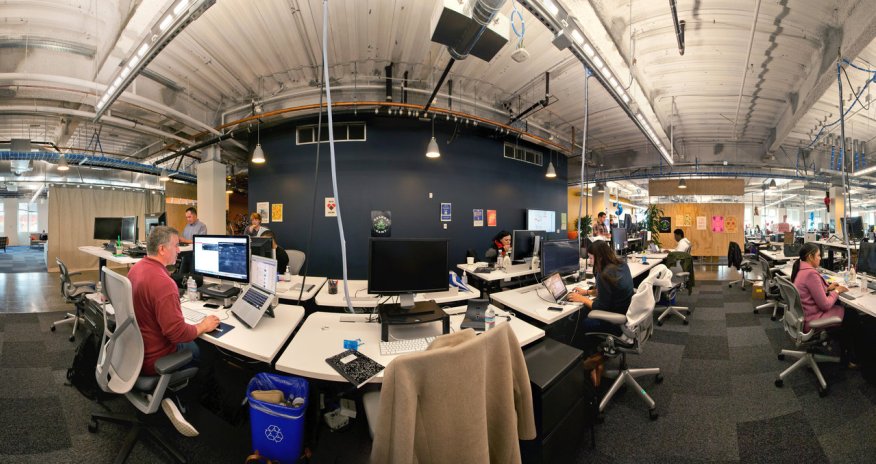


Couches in the casual areas, for example, can be replaced without warning. Similarly, design changes to Facebook’s home page are known as “moving the furniture around.”A vending machine keeps Facebook employees stocked with all the tech gear they need.And there are print and woodworking shops designed to keep Facebook’s computer-dwelling employees grounded in offline experiences so they’ll create more consumer-friendly software.Facebook’s Palace of ChangeFacebook’s headquarters in Menlo Park, Calif., is a cluster of 11 buildings enclosing a Disney-like pedestrian square and a two-way promenade. The complex has a cupcake store and a barbecue joint, a wood shop, a print shop and an arcade. In addition, there are two cafeterias, a candy shop, a taco stand, a burger stand, a pizza stand, a chopped-salad bar and three small restaurants. (A noodle shop is coming soon.) Everything is free or subsidized.The “Main Street, U.S.A.” feel is no accident. Sheryl Sandberg, the chief operating officer of Facebook, also serves on the board of Disney, and she brought in consultants from Anaheim and Orlando to perfect Facebook’s look. As in the Magic Kingdom itself, all of this fun is purposefully designed in the service of spontaneity.No one has an office, though Facebook’s chief executive, Mark Zuckerberg, occasionally holds meetings in a large glass cube in the middle of the campus.Facebook’s unofficial slogan is “hack,” an engineering term that has come to mean remaking something with an amateur’s passionate disregard for the usual rules. Facebook’s all-night hackathons aren’t just an echo of crashing out a project before a college final: They are efforts to keep experimenting, to try something new before some scrappy start-up does.Computer problems during an all-nighter? There are machines that dispense new computer peripherals, like keyboards, at no charge, if the help desk is closed.There are posters everywhere, including the employee entrances, that exhort change, hacking and fearlessness. Typical sentiments include “Taking risks gives me energy” and “What would you do if you weren’t afraid?” The guiding spirit is Mr. Zuckerberg’s own line: “The journey is 1 percent finished.”The buildings hold 6,000 people. In the past, Facebook moved around as many as 1,000 of them a month, reassigning them to new short-term projects. Walkways double as spaces for ambulatory meetings, held on the go so they are short and decisive.Casual meeting areas are set off from the open plan by squares of plywood hanging from the ceiling, a visual “under construction” reference meant to reinforce the company’s ethos. Facebook even spent money to expose its networking wires, which dangle along the ceiling.“It’s designed to change thinking,” said John Tenanes, who oversees Facebook’s buildings as its director of real estate. “Even if the meeting doesn’t move faster, we want people coming up with new stuff.”And sometimes fooling around with old stuff. There are print and woodworking shops to keep employees grounded in offline experiences, including personal projects and the printing of many of the wall posters, which the company hopes will help them create more consumer-friendly software. Bike repair shops, along with a bank and the free food, help keep people close to campus.Couches in the casual areas are often replaced with no advance warning. Similarly, design changes to Facebook’s home page are known as “moving the furniture around,” something that initially annoys consumers but pays off over the long haul, the company has found. People get used to change when change is expected.Mr. Tenanes has an unusual relationship with his buildings. He worked in them when they were the headquarters of Sun Microsystems, a once-highflying company that was overwhelmed by tech changes. “In those days, every engineer had his own office. With a door,” he said. “It was considered status to have a door.”Doors now seem an impediment, slowing the making of something new.Across the street from its current headquarters, Facebook has commissioned a new building from the architect Frank Gehry. According to Mr. Tenanes, its large, open-plan space will hold 2,800 people, with 18-foot windows that look out on a 10-acre park on one side and a tidal marsh on the other.For over a year, Facebook has scoured California for trees for the building’s rooftop plaza, which will also feature drought-resistant grasses. The plaza will have a coffee shop, a Shake Shack restaurant, a walking path and telescopes to witness the ever-changing marsh. A second path, at ground level, will accommodate bicyclists and walkers.“You’ll be surrounded by world-class engineers,” Mr. Tenanes said of the structure, “and never more than 24 feet from a wonderful outdoors.”(nytimes.com)ANN.Az












Latest news 
More news

 Photo
Photo 



 Video
Video