Computer robots will outsmart humans within 15 years
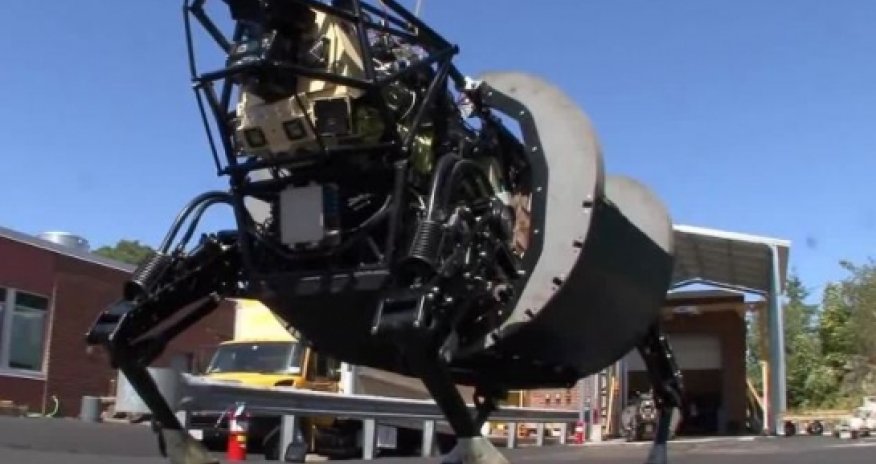


Computers will soon be able to learn from experience, tell jokes and even flirt, according to Ray Kurzweil, the company’s artificial intelligence (AI) expert.Google has spent billions of its £57bn fortune quietly buying up the world’s top robotics companies, including DeepMind, a British company which specialises in machine learning, and Boston Dynamics, which makes advanced military robots.Privacy campaigners have long attacked Google for hoovering up users’ personal information and selling it to advertisers.But Mr Kurzweil was recruited in 2012 to improve Google’s AI – with the aim of the search engine understanding what we are looking for better than we do.The 66-year-old entrepreneur and futureologist, who predicted the rise of the internet and that a world chess champion would one day be beaten by a computer, has said machines will outsmart their makers by 2029.In an interview with The Observer, he said: 'My project is ultimately to base search on really understanding what the language means.'When you write an article, you're not creating an interesting collection of words. You have something to say and Google is devoted to intelligently organising and processing the world's information.'We want [computers] to read everything on the web and every page of every book, then be able to engage in intelligent dialogue with the user to be able to answer their questions.'Boston Dynamics makes the LS3 walker robot, which resembles a horse, and can navigate almost any terrain including steep slopes, rocky ground and dense vegetation.Google also purchased smart thermostat company Nest Labs for £1.9billion. The Nest Lab alarm is able to speak to owners, telling them where in their house smoke is and what is causing it.Kurzweil became famous for his theory of 'the singularity', the moment when computers and humans will effectively become the same thing.In 1990 he predicted that a world chess champion would be defeated by computer in 1998. In reality it happened two years earlier than that, when in 1996 IBM's Deep Blue beat Garry Kasparov.He also foresaw the future uses of the internet in the days when it was still an obscure program being used by academics to store research data.He is now predicting that the 'Turing test' moment - when computers become cleverer than us - will be passed in 2029.In 2009 Kurzweil co-founded the Singularity University, partly funded by Google, an unaccredited graduate school devoted to his ideas and the aim of exploring exponential technologies.Kurzweil had worked on special projects with Google for many years, before he was offered a full-time job by Larry Page.His predictions are eerily similar to the plot of Oscar-nominated film Her, starring Joaquin Phoenix, in which a heartbroken man falls in love with his new computer.Theodore Twombly, played by Phoenix, ends up in a relationship with Samantha, his new computer operating system, which learns his behaviour and is able to have conversations with him.(dailymail.co.uk)ANN.Az











Latest news 
More news

 Photo
Photo 


 Video
Video