





Nasa reveal that our sun's rainbow colours are invisible to the naked eye
20.12.2013 12:31


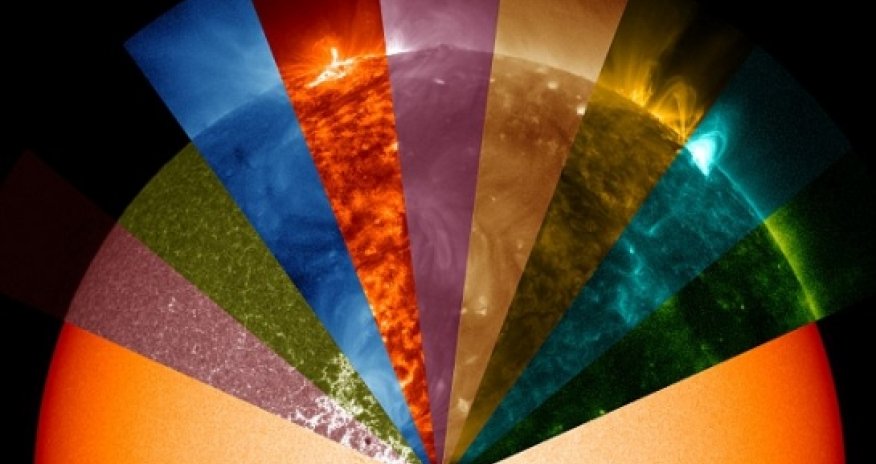
Nasa has released an incredible image that shows the dizzying array of colours that can be seen emanating from the sun in wavelengths that cannot be seen by the human eye.It was made possible by NASA's Solar Dynamics Observatory, or SDO, using the wide range of wavelengths that the telescope can view.SDO converts the wavelengths into an image humans can see, and the light is colourised into a rainbow of colors.Taking a photo of the sun with a standard camera will provide a familiar image: a yellowish, featureless disk, perhaps a bit more red when near the horizon since the light must travel through more of Earth's atmosphere and consequently loses blue wavelengths before getting to the camera's lens.The sun, in fact, emits light in all colours, but since yellow is the brightest wavelength from the sun, that is the colour we see with our naked eye - via the camera , since the sun should never be looked at directly.When all the visible colours come together, scientists call this 'white light'.We see the visible spectrum of light simply because the sun is made up of a hot gas – heat produces light just as it does in a light bulb.But when it comes to the shorter wavelengths, the sun sends out extreme ultraviolet light and x-rays because it is filled with many kinds of atoms, each of which give off light of a certain wavelength when they reach a certain temperature.Not only does the sun contain many different atoms – helium, hydrogen, iron, for example - but also different kinds of each atom with different electrical charges, known as ions.Each ion can emit light at specific wavelengths when it reaches a particular temperature.Solar telescopes make use of this wavelength information in two ways. For one, certain instruments, known as spectrometers, observe many wavelengths of light simultaneously and can measure how much of each wavelength of light is present.Different wavelengths convey information about different components of the sun's surface and atmosphere, so scientists use them to paint a full picture of our constantly changing and varying star.By examining pictures of the sun in a variety of wavelengths – as is done not only by SDO, but also by Nasa's Interface Region Imaging Spectrograph, its Solar Terrestrial Relations Observatory and the European Space Agency/Nasa Solar and Heliospheric Observatory - scientists can track how particles and heat move through the sun's atmosphere.(dailymail.co.uk)ANN.Az


Similar news
Similar news












 Photo
Photo 



 Video
Video