





Asteroid's moon seen during Earth flyby
27.01.2015 23:00


The asteroid that flew close to Earth Monday didn't come alone.
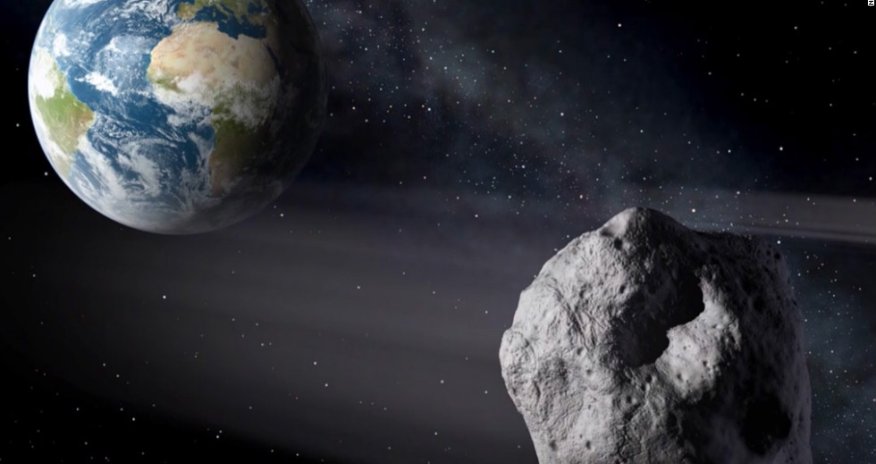
NASA images released Monday reveal the asteroid, officially known as 2004 BL86, has its own small moon. The grainy, black and white photos show the asteroid, about a third of a mile in size, spinning through space, with its 230-foot-wide moon trailing behind.
Asteroid 2004 BL86 came about 745,000 miles (1.2 million kilometers) from Earth, or about three times as far away as the moon, just after 11 a.m. ET Monday, according to NASA.
It was far enough that it didn't pose a threat to Earth, but close enough to give scientists and amateurs a chance to observe a large asteroid up close.
It was the closest known asteroid this large to pass near Earth until 2027, when an asteroid called 1999 AN10 flies by.
Observers on the ground didn't see much when the asteroid was closest to Earth Monday morning, because it wasn't at its brightest. Only a portion of its illuminated side was visible, according to Sky & Telescope magazine. The asteroid brightened as it got farther from the Earth because its face became more fully illuminated, the magazine said.
The best chance for viewing was from 8 p.m. ET Monday to 1 a.m. ET Tuesday.
NASA scientists snapped radar-generated images of the asteroid using the Deep Space Network antenna at Goldstone, California, and the Arecibo Observatory in Puerto Rico.
"While it poses no threat to Earth for the foreseeable future, it's a relatively close approach by a relatively large asteroid, so it provides us a unique opportunity to observe and learn more," Don Yeomans, the recently retired manager of NASA's Near Earth Object Program Office at the Jet Propulsion Laboratory in Pasadena, California, said in a NASA news release.
Yeomans retired on January 9 after 16 years of tracking asteroids. Paul Chodas has been designated as the new manager.
"We should be getting some great radar images of this asteroid," Chodas told CNN before the asteroid passed. "Radar would be the key to study the asteroid's surface, give an idea of its shape, whether it has rocks and that kind of stuff on it. It'll be really exciting."
Observers without binoculars or a scope watched from their computers on The Virtual Telescope Project 2.0.
The asteroid was discovered on January 30, 2004, by a telescope of the Lincoln Near-Earth Asteroid Research survey in White Sands, New Mexico.
Want to know more about asteroids? Check out NASA's asteroid watch program or follow it on Twitter.
(СNN)
ANN.Az


Similar news
Similar news












 Photo
Photo 



 Video
Video