





Ötzi the iceman's hidden tattoos uncovered
27.01.2015 13:24


It’s been almost 24 years since the body of Ötzi the iceman was unearthed, yet scientists are still discovering secrets about the 5,300-year-old mummy.
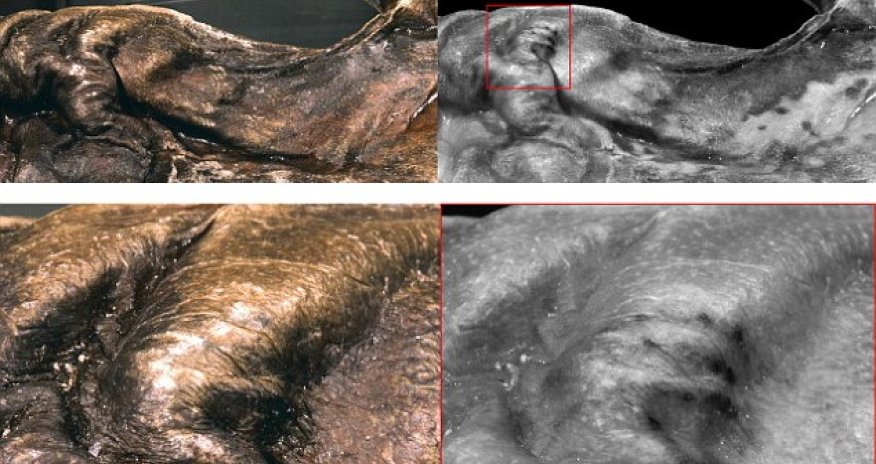
Using a modified camera, designed to capture a range of wavelengths, experts have spotted a previously unseen tattoo on the ancient specimen.
The markings were spotted near the ribcage on the lower right side of the body, and they are the first etchings found on the front of the torso.
In total, the ancient hunter has 61 tattoos grouped across 19 body parts, which the archaeologists previously thought were used as a primitive form of acupuncture.
However, they claim the new tattoo may contradict this theory.
The team have mapped these tattoos in the Elsevier Journal of Culture Heritage.
The recent scans of Ötzi’s body were taken by Marco Samadelli, Marcello Melis, Matteo Miccoli, Eduard Vigl, and Albert Zink from the European Academy of Bozen Institute for Mummies and the Iceman and the South Tyrol Museum of Archaeology.
They used a 36MP Nikon D800 camera fitted with filters that captured wavelengths, including ultraviolet, visible and infrared.
Using this camera, they found linear ink markings across the body, ranging from between 1mm (0.03 inches) and 3mm (0.1 inches) thick and between 7mm (0.2 inches) and 40mm (1.5 inches) long.
The majority of the tattoos consist of lines running parallel to each other, between 2mm (0.07 inches) and 8mm (0.3 inches) apart.
In two locations, however, including the right knee and left ankle, these lines form a cross.
The right leg has seven groups of tattoos, the left leg has four, and visible tattoos are also found on the back of the lumbar region.
The longest tattoos are around the wrist of the left hand, and many of these have been documented before.
However, using the modified camera, the researchers also found a previously unseen group of tattoos that is barely visible to the naked eye.
This tattoo was found in the right lower thoracic, and shows four parallel lines of length varying from 20mm (0.7 inches) to 25 mm (0.9 inches).
‘This is of particular interest, as this represents the first tattoo that was detected on the iceman's frontal part of the torso,’ explained the researchers.
The ice man's tattoos are largely seen on parts of the body that endured wear-and-tear, causing archaeologists to liken the practice to acupuncture.
Radiological images of the tattooed areas of the mummy show degenerative areas under the tattoos that could have caused pain.
‘In previous work on the tattoos of the iceman it was mainly believed that their application was done as a kind of treatment or diagnosis of health problems, in particular lower back pain and degenerative joint disease of his knees, ankle and wrist,’ continued the experts.
‘The conclusion was drawn because basically all tattoos were located in morphological areas close to the underlying spine and joints, where degenerations have been identified based on earlier radiological studies.’
But, the newly identified tattoo is not located close to a joint, which has led them to question this theory.
When the mummy was first studied, experts were shocked at Ötzi's tattooed skin as they had never seen real examples of Copper Age tattoos before.
They were also surprised as it is popularly thought that acupuncture was invented more than 2,000 years later in Asia.
(dailymail.co.uk)
ANN.Az


Similar news
Similar news












 Photo
Photo 



 Video
Video