





Was Einstein right?
30.01.2015 11:30


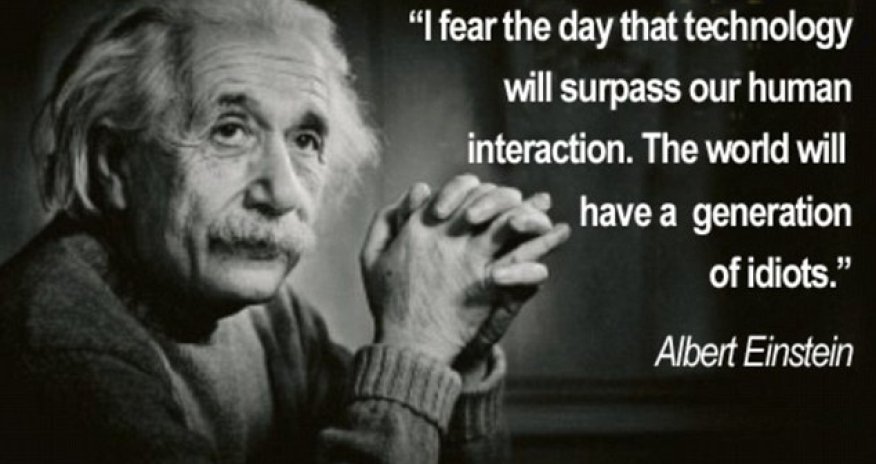
Long before the age of the mobile phone, Albert Einstein, one of the most brilliant brains of the 20th century, is said to have predicted: ‘I fear the day technology will surpass our human interaction. The world will have a generation of idiots.’
Some historians dispute the great man ever said it, but, whatever the case, it seems the prophecy may be coming true. Just look around you. Everywhere people are glued to their mobiles — as these photographs prove. Whether eating out with their family, sitting on the Tube, watching the tennis at Wimbledon, or even riding a bike, these Britons are all hooked on their phones.
Of course, we can all be guilty of it — and it doen’t mean we’re idiots — but to spare these people’s blushes, we’ve obscured their faces.
Surely, though, the question has to be asked: Is there really a need for us to be looking at our mobile phones every second of the day?
Even in the company of others, or out in the glorious countryside, people seem unable to detach themselves from this electronic fifth limb. Tragically, the infinite diversions of life, art and the universe are taking second place to that ubiquitous gadget.
A survey by a digital marketing firm found the average Briton with a smartphone uses it 221 times a day — on emails, texts and other social media. Typically, they first click on to their phone at 7.31am, and then keep tapping away — on and off — until 11.21pm.
For an average of three-and-a-quarter hours a day, our eyes are glued to our phones, blind to the world around us. That’s almost the equivalent of a whole day a week, stranded in cyberspace.
The effect is dehumanising. ‘We’re engaging face-to-face much less,’ says the respected scientist, Baroness Susan Greenfield, whose book, Mind Change, explains how the digital age is changing our brains for good and ill. ‘If we don’t speak to each other, it’s harder to establish empathy.’
Women are the worst culprits — using their phones for an average 23 minutes a day more than men. And the younger we are, the worse the condition gets. Adults between 18 and 24 spend four hours, 20 minutes a day on their smartphones. But even the over-55s — who grew up in that long-lost, magical land where people actually talked to each other — use them for two and a quarter hours a day.
Wherever we are — on holiday in the most dazzling surroundings on earth, with friends or even in the bath — nothing can rival the attraction of that ping signalling a new message, or the comforting buzz that means someone wants to get in touch with you.
(dailymail.co.uk)
ANN.Az


Similar news
Similar news












 Photo
Photo 



 Video
Video