





Hubble captures triple solar eclipse on Jupiter
09.02.2015 13:00


The Hubble space telescope peers hundreds, thousands, millions of light-years into the universe to study novas, quasars and nebulas.
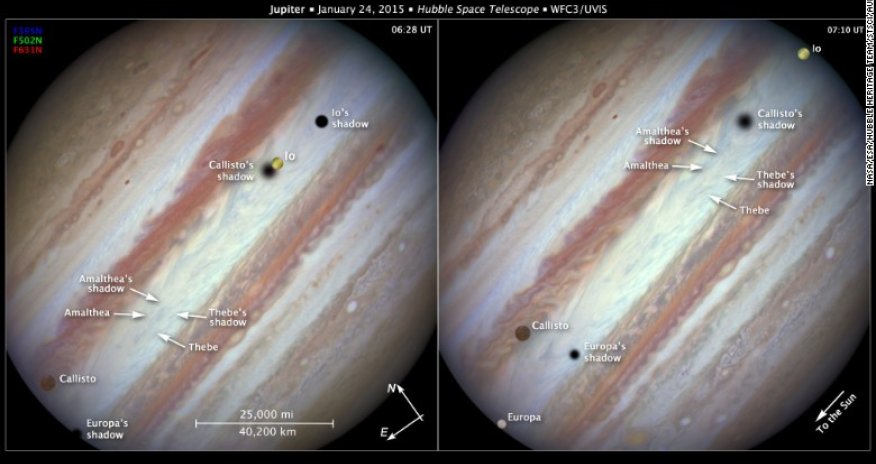
But weeks ago, it pulled its focus way in close -- to just light-minutes away -- to view a rare and beautiful spectacle at the planet Jupiter.
Three big moons crossed past it at the same time, casting their shadows onto Jupiter's swirling surface.
From the perspective of people theoretically standing on Jupiter, it would be like three solar eclipses happening at once, astronomers said.
A photo gift
In the last 15 years, this has happened only twice, the Space Telescope Science Institute said. "The next one will be 2032," said astronomer Carol Christian.
So, Hubble shot photos rapid fire to capture the rare conjunction in late January. And STScI published them Thursday, along with a short fast-motion video animation.
There was no great scientific gain in Hubble taking the snaps. The moons and their crossings have been examined plenty and are well-known.
"We felt that there are images which have aesthetic value above and beyond their scientific value," said astronomer Zolt Levy.
It was a gift of beauty to the public.
62 moons, 4 big ones
Jupiter is a sort of mini-solar system inside our solar system.
It's the largest body after the sun. And like the sun, it comprises a lot of helium and hydrogen gas, but it doesn't have enough mass to burst into the intense nuclear fusion that makes the sun a fireball, NASA says.
It has many satellites, including 62 moons, and they swarm around the planet with many of them crossing the surface facing Earth constantly.
But only four of them are highly visible standouts. They are Io, Europa, Ganymede and Callisto.
Just like Galileo
The four moons are called the Galilean satellites, because Renaissance astronomer Galileo Galilei discovered them in 1610, when he pointed his telescope skyward, forever changing human perception of our place in the cosmos.
Many of today's hobby telescopes are much stronger than his, so anyone can easily follow in his footsteps and cast the same gaze.
And many did, when the three moons passed, posting their recordings of the triple moon transit on YouTube.
(CNN)
ANN.Az


Similar news
Similar news












 Photo
Photo 



 Video
Video