





How you could catch HERPES from a sunbed
15.04.2015 19:27


We are well versed in the dangers of using sunbeds, with skin cancer preying on the minds of all who expose their skin to the UV rays.
But experts have warned the disease is not the only health danger associated with the pursuit of an artificial year-round tan.
Those compelled by a desire for bronzed skin are also at risk of catching a sexually transmitted infection - herpes.
Genital herpes is highly contagious and spreads from one person to another via skin-to-skin contact.
It is commonly passed on through sex and oral sex.
Once a person is infected with the virus it can reactivate every so often to cause a new episode of painful genital herpes.
There is no complete cure for the infection - rather, a sufferer will be given treatment each time they suffer a flare up.
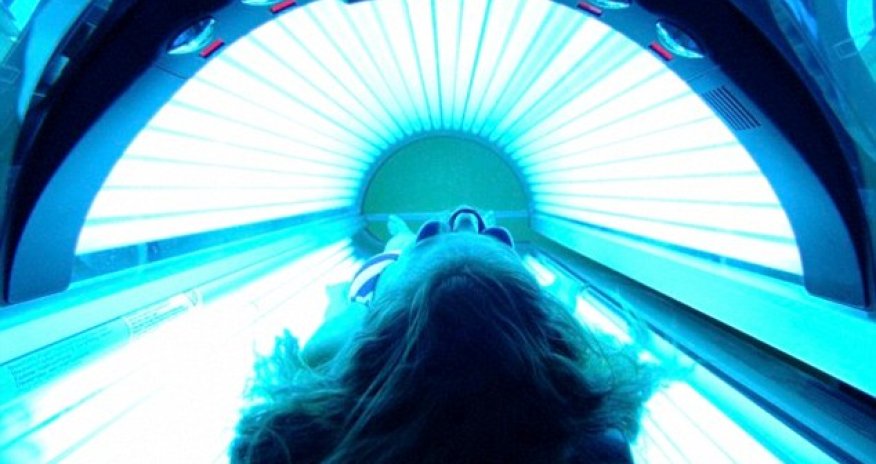
Dermatologist Dawn Marie Davies, an associate professor of dermatology at the Mayo Clinic in Minnesota, warns the virus, and other bacteria, can survive on tanning beds, despite the heat.
'In my practice, I've seen acquired bacterial infections, warts, and herpes infections from tanning beds,' she told Yahoo.
She said staphylococcus bacteria, which can cause skin infections, faecal bacteria, the herpes virus and the wart-causing human papillomavirus are all able to withstand the heat of a sunbed to survive.
Bacteria that lies on a person's skin can easily be transferred to the bed, when a person is lying down.
The heat - not high enough to kill the infection - allows the bacteria to develop to become stronger and more able to survive.
When a person sweats, it provides a breeding ground for bacteria or viruses.
It is then possible for the infection to transfer to another sunbed user, entering the body via a small cut or nick in the skin, often so small a person may be unaware.
'Ultraviolet light can theoretically kill germs, but it's not enough to kill germs on the tanning bed,' Professor Davies warned.
'What's interesting is that when you use the ultraviolet light over and over again - and the tanning bed lights are on for multiple hours a day - if the bacteria or virus is exposed to some antiseptic but not enough to kill it, or some light but not enough to kill it, it can grow stronger and then it becomes resistant.'
(dailymail.co.uk)
ANN.Az
www.ann.az


Similar news
Similar news












 Photo
Photo 



 Video
Video