





What makes a planet habitable?
19.08.2015 10:32


Water in liquid form is thought to be a necessity for life on Earth.
Naturally, some say that life may flourish under other conditions, and perhaps even in the absence of water.
While that may be true, take a look around - life seems to do quite well here on Earth and we've yet to find it elsewhere in our Solar System.
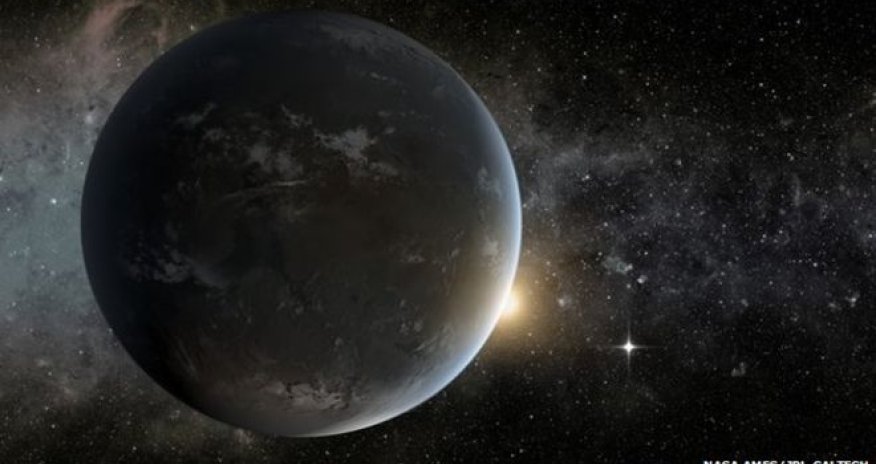
Based on this, let's look at the classical definition for the habitable zone as the region around a star, such as our own Sun, where the temperature of any orbiting planet permits water in liquid form.
Astrophysicists are extremely good at calculating the temperature of a star and then, taking into account the distance of a planet from its host star, it is easy to work out the planet's "equilibrium temperature".
The starlight (in our case, sunlight) that falls onto the planet is reradiated as heat and, hey presto, we have our actual planet temperature - simple. Except it isn't.
Greenhouse gases
What if the planet sports a blanket of white clouds? Clouds are reflective and therefore will cool the planet, acting to push the habitable zone closer to the star.
Amusingly, if we calculate this "equilibrium temperature" for the Earth, taking into account its beautifully reflective clouds, then it turns out that we live outside the classical habitable zone!
The same calculation for Venus gives an expected equilibrium temperature of about -10°C, but in reality it is more like 450°C.
What happened?
Both these planets have greenhouse gases present in their atmospheres, warming the planet up and driving the outer boundary of the habitable zone further away from the star (while clouds drive the inner boundary closer to the star).
The very latest habitable zone definitions use simulations of these cloud and greenhouse effects - widening and blurring the crude classical definition.
Throw into the mix that we currently can't study the atmospheres of rocky terrestrial exoplanets (and therefore have no idea whether they have clouds, greenhouse gases, or even an atmosphere at all!) - then to say "that planet is habitable" is impossible, for the time-being at least.
What is an exoplanet?
Planets beyond our Solar System are often given the term "exoplanet"
The first exoplanet was discovered in 1992, orbiting a pulsar (a neutron star that emits electromagnetic radiation)
A few years later, the planet 51 Pegasi B was found orbiting a star similar to the Sun
More than 1,000 have been detected to date using several techniques
Thousands more "candidates" await confirmation
Many of these worlds are large planets believed to resemble Jupiter or Neptune
Many gas giants have been found to be orbiting very close to their stars
This has prompted new ideas to describe the formation and evolution of solar systems
Just to complicate matters, the habitable zone also depends on the type of star the planet orbits. The more massive and hotter the star, the further out the habitable zone will lie.
Conversely, small cool stars will have a habitable zone that is much closer in.
Indeed, "red dwarf" stars are so cool and dim that a planet in the habitable zone might have a "year" that lasts only a few days, so feeble is the red dwarf's light.
Stellar blasts
This would raise other problems for life on such a planet. Red dwarfs like to chuck out large flares, stellar eruptions that release charged particles and X-rays.
Given the close proximity of the planet, this might cause substantial atmospheric losses.
High doses of radiation also tend to be harmful to biological material, and X-rays are capable of dissociating water - thereby depleting any water supply. Not ideal.
Maybe things are better around hotter stars, where a habitable planet would lie further way from any nasty stellar blasts?
Well, now we run into another problem, that of the lifetime of the star.
(BBC)
www.ann.az


Similar news
Similar news












 Photo
Photo 



 Video
Video