





Is this the first human?
11.09.2015 23:00


The fossilised remains of a previously unknown species of human has been discovered inside a cave in South Africa.
Named Homo naledi, the species has been assigned to the genus Homo, to which modern humans also belong.
Scientists unearthed more than 1,500 bones belonging to at least 15 individuals which are yet to be dated
They say they could be anything between 20,000 and two million years old.
The discovery came about thanks to a tip-off from cavers two years ago, who had glimpsed what looked like human remains through a crack in a limestone wall.
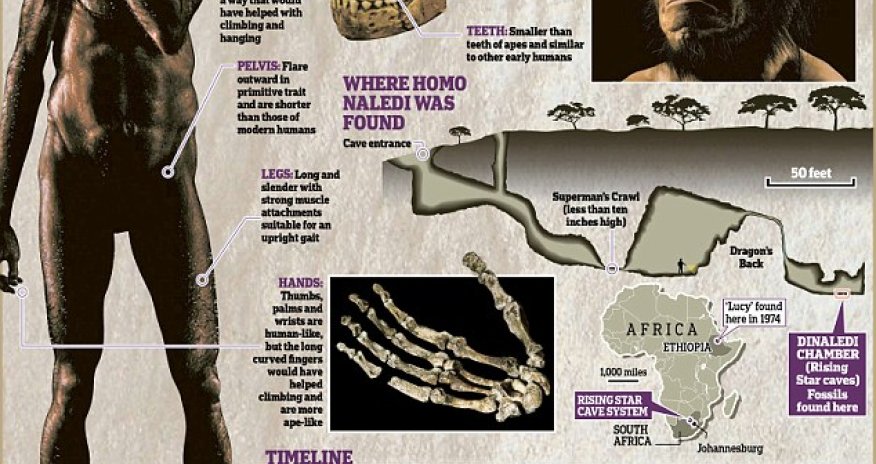
The bones were located in the Rising Star cave system in South Africa's Gauteng province, part of the Cradle of Humankind World Heritage Site, in a remote chamber that can only be accessed via several steep climbs and fissures.
The chamber, situated down a narrow 40ft (12 metre) chute, measures around 30 feet (9 metres) long and just a few feet wide, National Geographic reported.
It is not yet clear how more than a dozen H. naledi skeletons - ranging from babies to elderly individuals - ended up in a remote region of a large cave.
The researchers have not ruled out the possibility of the bodies being disposed of in the cave deliberately, or a catastrophic 'death trap' scenario in which the humans entered the cave and all died of an unknown cause.
If the burial scenario is correct, the creatures would have introduced artificial light into the caves in the form of torches as the narrow passages are entirely devoid of light.
The bones are in phenomenal condition - with even the delicate inner ear bones of the new species lying intact.
Professor Chris Stringer, Research Leader in Human Origins at the Natural History Museum in London, said: 'The deep cave location where the bones were found suggests that they may have been deposited there by other humans, indicating surprisingly complex behaviour for a 'primitive' human species.'
Scientists say that many more examples of the new species may lay uncovered in the remote cave system.
The finding has provided a challenge for the international team of scientists who have been tasked with analysing and aging the bones, Dr Stronger added: 'Some of Homo naledi's features, such as its hands, wrist and feet, are very similar to those of modern humans.
(dailymail.co.uk)
www.ann.az


Similar news
Similar news











 Photo
Photo 



 Video
Video