





How the most expensive structure in the world was built
22.12.2015 19:30


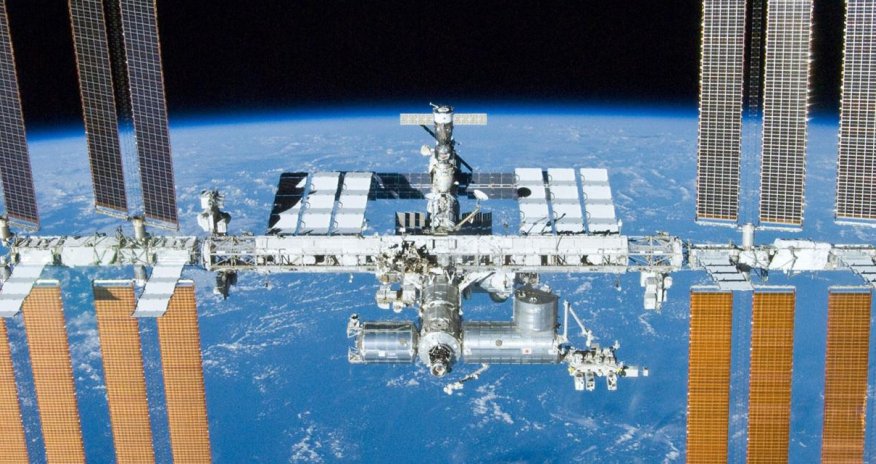
The International Space Station is a masterpiece of engineering and human ingenuity. But this $100bn project has been beset by politics, compromise and tragedy. Richard Hollingham, who witnessed the launch of the first section of the station for the BBC in 1998, investigates how we ended up with the ISS.
In mission control rooms around the world – in Houston, Moscow and Munich – a daily reality TV show is played out on giant screens. It is the dullest reality show you will ever watch. There is no conflict or peril, little tension and certainly no romance. The best you can hope for is a view of an astronaut’s backside floating past the camera.
This is the reality of day-to-day life on the International Space Station (ISS): astronauts living and working together to strict timelines – eating, sleeping, exercising, conducting scientific experiments and fixing the plumbing.
It may not be Apollo 13, but this is exactly the way the space agencies like it. Since the ISS was first permanently occupied in 2000, Russian, American, Japanese, Canadian and European astronauts have lived and worked together 400 kilometres (250 miles) above the Earth. One of the greatest triumphs of the ISS is to make space appear routine, boring even.
We should not, however, take the apparent success of the ISS for granted or ever imagine space travel to be as easy as it looks. And when you investigate the story of how we ended up with a giant orbiting laboratory, circling the planet every 90 minutes, it is remarkable the ISS was ever built at all.
I have never been so cold. Huddled out of the bitter wind behind a rock in the middle of the Kazakh Steppe, with a phone clutched to my ear, I am attempting to commentate for BBC radio on the launch of the first stage of the ISS.
I am one of only three international journalists who have managed to jump through the bureaucratic hoops to make it this far. The Russians are not used to allowing international media into the once top-secret Baikonur Cosmodrome. They clearly, however, have a sense of humour: the flat area we are standing on turns out to be the cover of a nuclear missile silo.
Behind us an ancient loudspeaker crackles into life with a monologue detailing the events leading up to launch. In the distance, blending into the grey sky, the white Proton rocket carrying the Zarya module.
There is no countdown. The launch time comes, and the rocket goes. A few seconds later and the noise hits, a throaty roar disappearing into the thick cloud.
Despite the dismal weather, the launch is undeniably spectacular and merits a headline on the evening news bulletins. But the media narrative surrounding the event has been, for the most part, sceptical. Already the project is over-budget and the Zarya launch more than a year behind schedule.
Most people I interview doubt the ambitious space programme will ever be fully realised. Despite being a signatory of the original ISS agreement, Britain declines to put any money into the project. One senior UK government official tells me it is "an orbiting white elephant”.
It is not an auspicious start.
"Within Nasa people tend to be overly optimistic and outside of Nasa people tend to be overly sceptical about these big projects,” says Valerie Neal, space historian at the National Air and Space Museum in Washington DC.
"There was never really a strong push to abandon it but there were threats,” she says. "It was very nearly killed by a single vote at one of the committees of the US Congress.”
But there has always been more to the ISS than just another space mission. Its political and diplomatic roles have been just as important as its scientific ambition.
"It is a symbol of what technologically advanced and aspirational nations can do,” says Neal.
The idea of a space station dates back more than a century. It is the logical step for space-faring civilisations between one-off missions to orbit and longer missions to the Moon and Mars. As the Space Age dawned in the 1950s, visionaries such as V2 designer Wernher von Braun plotted out a course that envisaged a permanently occupied orbital station as a staging post for the journey into deep space.
"That was the thinking until 1961,” says Nasa chief historian Bill Barry. "Then President Kennedy says ‘no, we’re going to sprint to the Moon’ and the whole idea of a space station gets put on the back-burner.”
But with the race to the Moon won, Nasa returned to the White House with a plan to build a space station and a reusable shuttle to service it. After almost two years of deliberation, the answer came back.
"The decision was to build the Space Shuttle,” says Barry. "President Nixon realised that they really needed not to kill the space industry and the least expensive option was to build the Space Shuttle.”
There was an obvious flaw in this plan: there was little point in having the shuttle without a space station.
The Soviet Union, meanwhile, saw an opportunity. "They had a very energetic programme to beat the Americans to the Moon,” says Barry. "They didn’t want to admit that in public so their answer was, ‘We were planning to build a space station all along’.”
While the US continued its Apollo Moon missions to dwindling public interest, on 19 April 1971 the Soviets launched Salyut 1 – the world’s first space station. Two months later a three-man crew docked and took up residence above the Earth. The cosmonauts spent three weeks living and working in the 20-metre-long cylinder, setting a new space duration record.
On 29 June, the three cosmonauts boarded their Soyuz spacecraft for the return to Earth. But during re-entry into the Earth’s atmosphere a faulty valve opened, sucking the air out of the capsule. Without spacesuits, the crew were killed in seconds. The first anyone knew of the tragedy was when ground support staff opened the spacecraft hatch.
Back in the USA, with the Moon programme cut short and the Space Shuttle still on the drawing board, Nasa had several enormous Saturn 5 rockets and state of the art Apollo space capsules going spare. Cobbling together a space station programme out of the two was not a giant leap of imagination.
"Skylab was vital for underpinning the resurgence of interest in having a more permanent station,” says David Baker, a former Nasa engineer-turned-author, who worked on the Apollo, Shuttle and space station programmes. "Instead of having to design each element, [we] simply took what existed and morphed it into something you could use for a different purpose.”
"The third stage shell of the Saturn 5 was fitted out with separate compartments,” says Baker. "Crews could remain there for three months at a single visit.”
Two complete Skylab laboratories were built, but only one was launched. Today, the other takes pride of place in the Smithsonian Air and Space Museum in Washington DC, where you can walk through its luxuriously roomy interior. The design owes more to the science fiction concepts of how a space station should look than the cluttered reality of the ISS.
Skylab contained laboratories, sleeping and rest areas; there was even a shower – a design that even those with only a tentative understanding of weightlessness can see is deeply flawed. Above the compartments there was an open area where astronauts could enjoy the thrills of microgravity aerobatics.
(BBC)
www.ann.az


Similar news
Similar news












 Photo
Photo 



 Video
Video