





The strange fate of a person falling into a black hole
25.12.2015 23:00


It could happen to anyone. Maybe you're out trying to find a new habitable planet for the human race, or maybe you're just on a long walk and you slip. Whatever the circumstances, at some point we all find ourselves confronted with the age-old question: what happens when you fall into a black hole?
You might expect to get crushed, or maybe torn to pieces. But the reality is stranger than that.
The instant you entered the black hole, reality would split in two. In one, you would be instantly incinerated, and in the other you would plunge on into the black hole utterly unharmed.
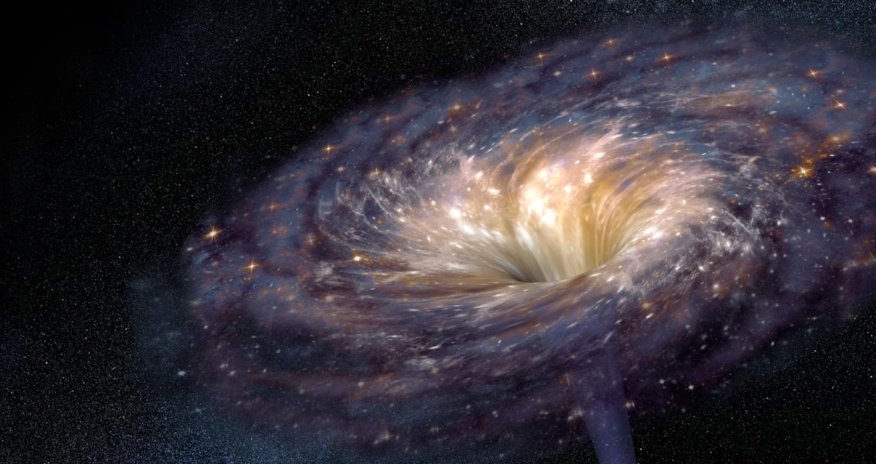
A black hole is a place where the laws of physics as we know them break down. Einstein taught us that gravity warps space itself, causing it to curve. So given a dense enough object, space-time can become so warped that it twists in on itself, burrowing a hole through the very fabric of reality.
A massive star that has run out of fuel can produce the kind of extreme density needed to create such a mangled bit of world. As it buckles under its own weight and collapses inward, space-time caves in with it. The gravitational field becomes so strong that not even light can escape, rendering the region where the star used to be profoundly dark: a black hole.
The outermost boundary of the hole is its event horizon, the point at which the gravitational force precisely counteracts the light's efforts to escape it. Go closer than this, and there's no escape.
The event horizon is ablaze with energy. Quantum effects at the edge create streams of hot particles that radiate back out into the universe. This is called Hawking radiation, after the physicist Stephen Hawking, who predicted it. Given enough time, the black hole will radiate away its mass, and vanish.
As you go deeper into the black hole, space becomes ever more curvy until, at the centre, it becomes infinitely curved. This is the singularity. Space and time cease to be meaningful ideas, and the laws of physics as we know them — all of which require space and time — no longer apply.
So what happens if you accidentally fall into one of these cosmic aberrations? Let's start by asking your space companion — we'll call her Anne — who watches in horror as you plunge toward the black hole, while she remains safely outside. From where she's floating, things are about to get weird.
As you accelerate toward the event horizon, Anne sees you stretch and contort, as if she were viewing you through a giant magnifying glass. What's more, the closer you get to the horizon the more you appear to move in slow motion.
You can't shout to her, as there's no air in space, but you might try flashing her a Morse message with the light on your iPhone (there's an app for that). However, your words reach her ever more slowly, the light waves stretching to increasingly lower and redder frequencies: "Alright, a l r i g h t, a l r i…"
When you reach the horizon, Anne sees you freeze, like someone has hit the pause button. You remain plastered there, motionless, stretched across the surface of the horizon as a growing heat begins to engulf you.
According to Anne, you are slowly obliterated by the stretching of space, the stopping of time and the fires of Hawking radiation. Before you ever cross over into the black hole's darkness, you're reduced to ash.
But before we plan your funeral, let's forget about Anne and view this gruesome scene from your point of view. Now, something even stranger happens: nothing.
You sail straight into nature's most ominous destination without so much as a bump or a jiggle – and certainly no stretching, slowing or scalding radiation. That's because you're in freefall, and therefore you feel no gravity: something Einstein called his "happiest thought".
After all, the event horizon is not like a brick wall floating in space. It's an artefact of perspective. An observer who remains outside the black hole can't see through it, but that's not your problem. As far as you're concerned there is no horizon.
Sure, if the black hole were smaller you'd have a problem. The force of gravity would be much stronger at your feet than at your head, stretching you out like a piece of spaghetti. But lucky for you this is a big one, millions of times more massive than our Sun, so the forces that might spaghettify you are feeble enough to be ignored.
In fact, in a big enough black hole, you could live out the rest of your life pretty normally before dying at the singularity.
How normal could it really be, you might wonder, given that you're being sucked toward a rupture in the space-time continuum, pulled along against your will, unable to head back the other way?
But when you think about it, we all know that feeling, not from our experience with space but with time. Time only goes forwards, never backwards, and it pulls us along against our will, preventing us from turning around.
This isn't just an analogy. Black holes warp space and time to such an extreme that inside the black hole's horizon, space and time actually swap roles. In a sense, it really is time that pulls you in toward the singularity. You can't turn around and escape the black hole, any more than you can turn around and travel back to the past.
At this point you might want to stop and ask yourself a pressing question: What the hell is wrong with Anne? If you're chilling inside the black hole, surrounded by nothing weirder than empty space, why is she insisting that you've been burned to a crisp by radiation outside the horizon? Is she hallucinating?
Actually, Anne is being perfectly reasonable. From her point of view, you really have been burned to a crisp at the horizon. It's not an illusion. She could even collect your ashes and send them back to your loved ones.
In fact, the laws of nature require that you remain outside the black hole as seen from Anne's perspective. That's because quantum physics demands that information can never be lost. Every bit of information that accounts for your existence has to stay on the outside of the horizon, lest Anne's laws of physics be broken.
On the other hand, the laws of physics also require that you sail through the horizon without encountering hot particles or anything out of the ordinary. Otherwise you'd be in violation of Einstein's happiest thought, and his theory of general relativity.
So the laws of physics require that you be both outside the black hole in a pile of ashes and inside the black hole alive and well. Last but not least, there's a third law of physics that says information can't be cloned. You have to be in two places, but there can only be one copy of you.
Somehow, the laws of physics point us towards a conclusion that seems rather nonsensical. Physicists call this infuriating conundrum the black hole information paradox. Luckily, in the 1990s they found a way to resolve it.Leonard Susskind realized that there is no paradox, because no one person ever sees your clone. Anne only sees one copy of you. You only see one copy of you. You and Anne can never compare notes. And there's no third observer who can see both inside and outside a black hole simultaneously. So, no laws of physics are broken.
Unless, that is, you demand to know which story is really true. Are you really dead or are you really alive?
The great secret that black holes have revealed to us is that there is no really. Reality depends on whom you ask. There's Anne's really and there's your really. End of story.
Well, almost. In the summer of 2012, the physicists Ahmed Almheiri, Donald Marolf, Joe Polchinski and James Sully, collectively known as AMPS, devised a thought experiment that threatened to upend everything we thought we knew about black holes.
(BBC)
www.ann.az


Similar news
Similar news












 Photo
Photo 



 Video
Video