





How the world's biggest sapphire grew so large
07.01.2016 22:00


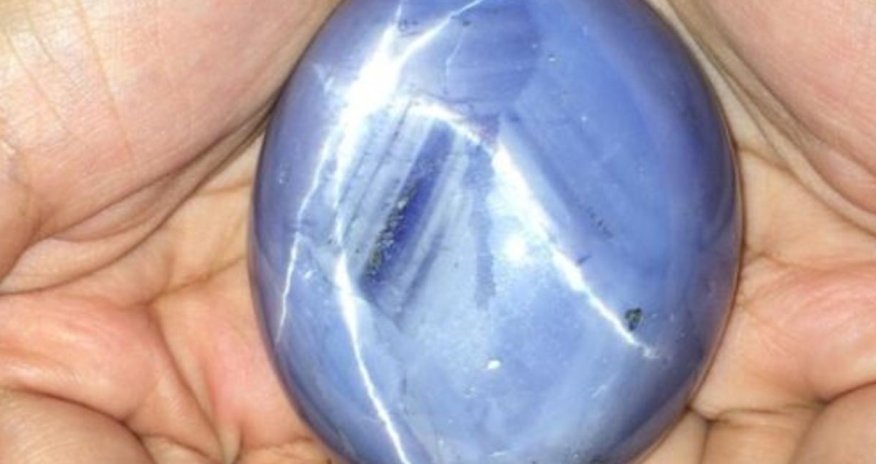
The world's largest ever blue sapphire has been unveiled, discovered in Sri Lanka's Ratnapura mines.
It weighs an astonishing 1404.49 carats, equivalent to about 280g (just under 10 ounces). Local gemologists say they have never seen a larger sapphire.
It is a type of gem known as a "star sapphire", due to the six-pointed star within the gem. This occurs because of the way light reflects from crystals trapped within it.
Its anonymous owner spoke to the BBC and suggests it could sell for up to $175m.
BBC Earth spoke to mineral scientist Simon Redfern from the University of Cambridge in the UK, to find out how such enormous gems can form.
Making sapphires is a lengthy process. This particular sapphire would have formed within the rocks of Sri Lanka's highlands.
The rocks are mostly granites, which form when molten magma cools and solidifies. But they have been subjected to intense heat and pressure.
"The granites have been dated as almost two billion years old, and were subsequently squeezed and re-worked in a massive metamorphic mountain-building episode that happened more than 500 million years ago," says Redfern. "Temperatures and pressures deep within the roots of these mountains would have reached more than 900C and over 9000 atmospheres pressure."
The sapphire could have formed within the granite itself before it was re-worked, or later when the rocks were being heated and squeezed.
"In either case, the temperatures and pressures would have changed only very slowly over millions and millions of years," says Redfern. "This is how the crystal was able to grow so big."
After the gem formed, it sat within the rocks while they were uplifted into mountains, which were then eroded. "And so it was brought to the surface, picked out of the rock by the forces of rain and weathering, and transported down river to the gem sands of Ratnapura," says Redfern.
Minerals such as sapphire can only survive journeys like this because they are so hard. Other, softer rocks would have eroded into mud and sand, helped along Sri Lanka's river beds by the country's heavy rainfall.
Sapphires are so hard because they are formed from corundum, an aluminium oxide. "Corundum is the hard gritty stuff used as an abrasive in emery paper," says Redfern.
"If you add just a trace of iron and titanium to the mixture of aluminum and oxygen from which the corundum is growing, it forms as sapphire. So sapphire is 'dirty' corundum - corundum with a trace of iron and titanium."
(BBC)
www.ann.az


Similar news
Similar news











 Photo
Photo 



 Video
Video