





Bronze Age houses uncovered in Cambridgeshire 'best ever'
12.01.2016 19:30


Archaeologists have uncovered what they believe to be the "best-preserved Bronze Age dwellings ever found in Britain".
The circular wooden houses, built on stilts, form part of a settlement at Must Farm quarry, in Cambridgeshire, and date to about 1000-800 BC.
A fire destroyed the posts, causing the houses to fall into a river where silt helped preserve the contents.
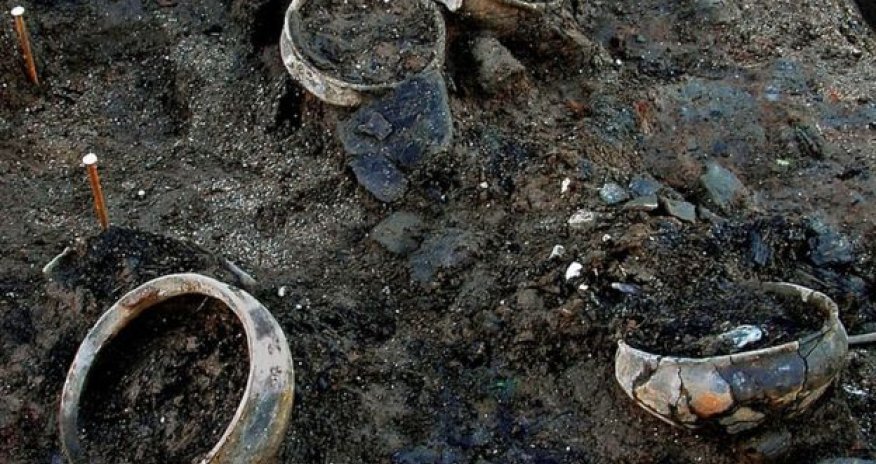
Pots with meals still inside and clothing have been found at the site.
An earlier test trench at the site, near Whittlesey, revealed small cups, bowls and jars.
In addition, archaeologists said "exotic" glass beads that formed part of a necklace "hinted at a sophistication not usually associated with the Bronze Age".
'Frozen in time'
Textiles made from plant fibres such as lime tree bark have also been unearthed.
However, the roundhouses themselves are now being excavated.
The work to uncover the settlement was necessary as the water level at the site was falling, meaning the remains of the houses could not be preserved in situ.
Duncan Wilson, chief executive of Historic England, which is jointly funding the excavation with land owner Forterra, described the settlement and contents as "an extraordinary time capsule".
He added: "A dramatic fire 3,000 years ago, combined with subsequent waterlogged preservation, has left to us a frozen moment in time, which gives us a graphic picture of life in the Bronze Age.
"This site is of international significance and its excavation really will transform our understanding of the period."
'Unsurpassed finds'
David Gibson, from Cambridge Archaeological Unit, which is leading the excavation, said: "So much has been preserved, we can actually see everyday life during the Bronze Age in the round.
"It's prehistoric archaeology in 3D, with an unsurpassed finds assemblage both in terms of range and quantity."
Well-preserved charred roof timbers of one of the roundhouses is clearly visible, together with timbers with tool marks and a perimeter of wooden posts known as a palisade which once enclosed the site.
Archaeologists digging two metres (6ft) below the modern surface also found preserved footprints believed to be from people who once lived there.
Once the items have been cleaned and documented they are expected to be put on public display.
(BBC)
www.ann.az


Similar news
Similar news












 Photo
Photo 



 Video
Video