


Juno probe returns first in-orbit Jupiter photo
13.07.2016 12:31


The American space agency's new Juno mission to Jupiter has returned its first imagery since going into orbit around the gas giant last week.
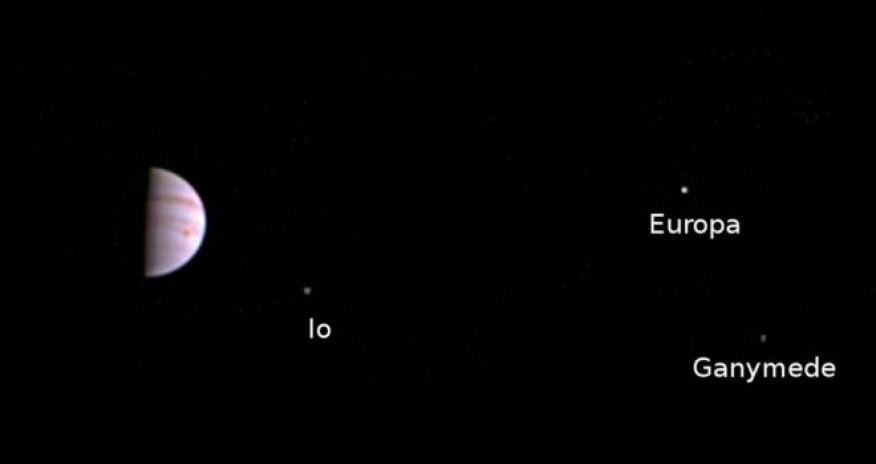
The picture shows a sunlit portion of the planet, together with three of its big moons - Io, Europa and Ganymede.
The fourth major satellite - Callisto - is out of view.
Juno is currently moving away from Jupiter on a large arc, but will sweep back in during August, enabling its "JunoCam" to take even better images.
At the moment, scientists are just relieved to know that the equipment is in good health after its encounter with Jupiter's harsh radiation environment during the spacecraft's orbit insertion manoeuvre on 5 July (GMT).
The mission team is now turning on all the probe's instruments to check their status.
A period of calibration lies ahead before the serious business of studying Jupiter begins in October.
It should be mid-way through that month that a further engine burn puts the spacecraft in a tight, 14-day orbit around the planet.
There will then follow a good 30-plus revolutions of the massive world, with many passes getting under 5,000km from its cloud tops.
The image on this page was acquired on Sunday, when Juno was some 4.3 million km from Jupiter.
Evident in the picture are the gas giant's coloured atmospheric bands. Unmistakable, also, is the famous Great Red Spot - the colossal storm that has raged on the planet for hundreds of years.
Juno's goal over the next 18 months will be to try to understand what makes Jupiter tick.
Scientists plan to use the spacecraft's instruments to sense the planet's deep interior. They think the structure and the chemistry of its insides hold the essential clues to how this giant world formed some four-and-a-half-billion years ago.
Jupiter is 11 times wider than Earth and 300 times more massive
It takes 12 Earth years to orbit the Sun; a 'day' is 10 hours long
In composition it resembles a star; it's mostly hydrogen and helium
Under pressure, the hydrogen becomes an electrically conducting fluid
This 'metallic hydrogen' is likely the source of the magnetic field
Most of the visible cloudtops contain ammonia and hydrogen sulphide
Jupiter's 'stripes' are created by strong east-west winds
The Great Red Spot is a giant storm vortex twice as wide as Earth
(BBC)
www.ann.az


Similar news
Similar news












 Photo
Photo 



 Video
Video