





Cosmic inflation: BICEP 'underestimated' dust problem
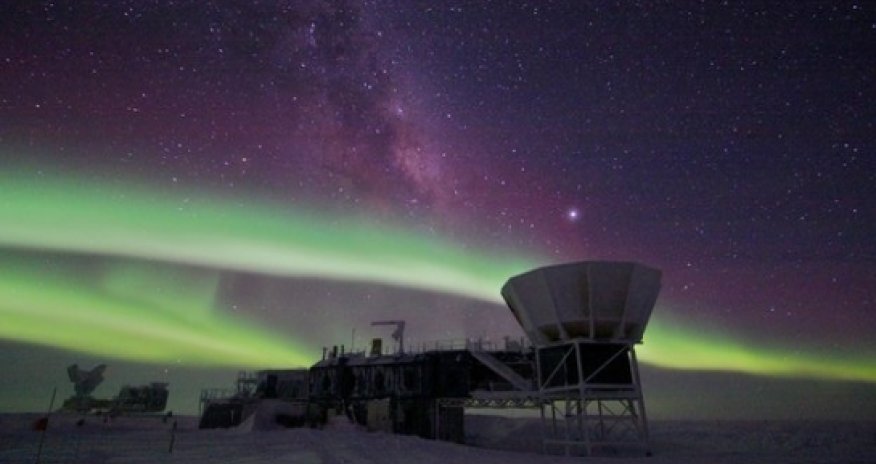


In March, the US BICEP team said it had found a pattern on the sky left by the rapid expansion of space just fractions of a second after the Big Bang.The astonishing assertion was countered quickly by others who thought the group may have underestimated the confounding effects of dust in our own galaxy.That explanation has now been boosted by a new analysis from the European Space Agency's (Esa) Planck satellite.In a paper published on the arXiv pre-print server, Planck's researchers find that the part of the sky being observed by the BICEP team contained significantly more dust than it had assumed.This new information does not mean the original claim is now dead. Not immediately, anyway.Cosmic 'ripples'The BICEP and Planck groups are currently working on a joint assessment of the implications, and this will probably be released towards the end of the year.However, if the contention is eventually shown to be unsupportable with the available data, it will prove to be a major disappointment, especially after all the initial excitement and talk of Nobel Prizes.What BICEP (also known as BICEP2) claimed to have done was find the long-sought evidence for "cosmic inflation".This is the idea that the Universe experienced an exponential growth spurt in its first trillionth of a trillionth of a trillionth of a second.The theory was developed to help explain why deep space looks the same on all sides of the sky - the notion being that a very rapid expansion in the earliest moments could have smoothed out any unevenness.Inflation makes a very specific prediction - that it would have been accompanied by waves of gravitational energy, and that these ripples in the fabric of space-time would leave an indelible mark on the "oldest light" in the sky - the famous Cosmic Microwave Background (CMB).The BICEP team said its telescope at the South Pole had detected just such a signal.Cosmic 'ripples'It is called B-mode polarisation and takes the form of a characteristic swirl in the directional properties of the CMB light.But it is a fiendishly difficult observation to make, in part because the extremely faint B-mode polarisation from nearly 14 billion years ago has to be disentangled from the polarisation being generated today in our Milky Way Galaxy.The main source of this inconvenient "noise" is spinning dust grains.These countless particles become trapped and aligned in the magnetic fields that thread through our galaxy.As a consequence, these grains also emit their light with a directional quality, and this is capable of swamping any primordial background signal.The BICEP team's strategy was to target the cleanest part of the sky, over Antarctica, and it used every piece of dust information it could source to do the disentanglement.What it lacked, however, was access to the dust data being compiled by Europe's Planck satellite, which has mapped the microwave sky at many more frequencies than the American team.This allows it to more easily characterise the dust and discern its confounding effects.(BBC)Bakudaily.Az














 Photo
Photo 



 Video
Video