




Greeks captivated by Alexander-era tomb at Amphipolis - PHOTO
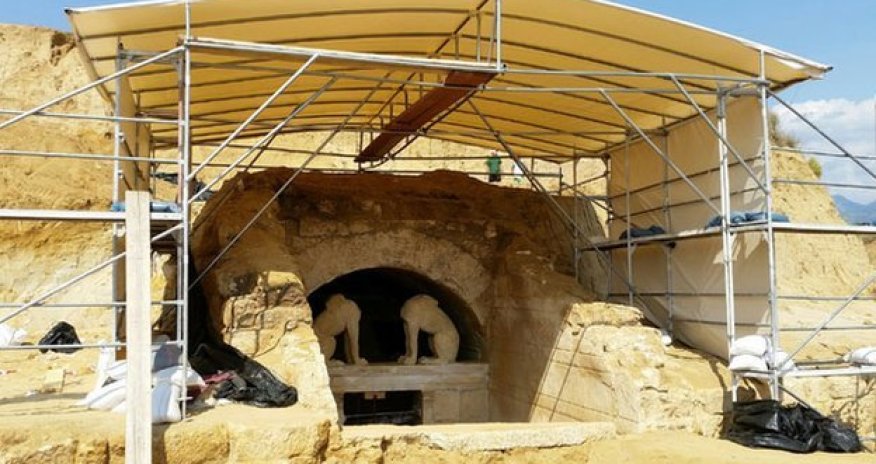


Who, they are asking, is buried within.In early August, a team of Greek archaeologists led by Katerina Peristeri unearthed what officials say is the largest burial site ever to be discovered in the country. The mound is in ancient Amphipolis, a major city of the Macedonian kingdom, 100km (62 miles) east of Thessaloniki, Greece's second city.The structure dates back to the late 4th Century BC and is 500m (1,600ft) wide, dwarfing the burial site of Alexander's father, Philip II, in Vergina, west of Thessaloniki."We are watching in awe and with deep emotion the excavation in Amphipolis," Greek Culture Minister Konstantinos Tasoulas told the BBC."This is a burial monument of unique dimensions and impressive artistic mastery. The most beautiful secrets are hidden right underneath our feet."The caryatids' modern counterparts are sitting in a police car, some 200m (650 feet) from the tomb's entrance.The dig site is protected 24 hours a day by two police officers.Their mission is to keep away the scores of journalists and tourists who arrive here by a winding dirt road from the nearby village of Mesolakkia.An imposing no-entry traffic sign serves the same purpose.The excavation team has made no statement regarding the identity of the tomb's occupant.But this has not prevented the media, archaeologists and laypersons alike from becoming embroiled in an often heated guessing game.Archaeologists agree that the magnificence of the tomb means it was built for a prominent person - perhaps a member of Alexander's immediate family; maybe his mother, Olympias, or his wife, Roxana -or some noble Macedonian.Others say it could be a cenotaph.But only the excavation team can give definitive answers, and progress has been slow since the workers discovered a third chamber that is in danger of collapse.(BBC)Bakudaily.Az










 Photo
Photo 


 Video
Video