




Scientist bleaches and dyes dead creatures to reveal their amazing inner anatomy - PHOTO
18.12.2013 18:00


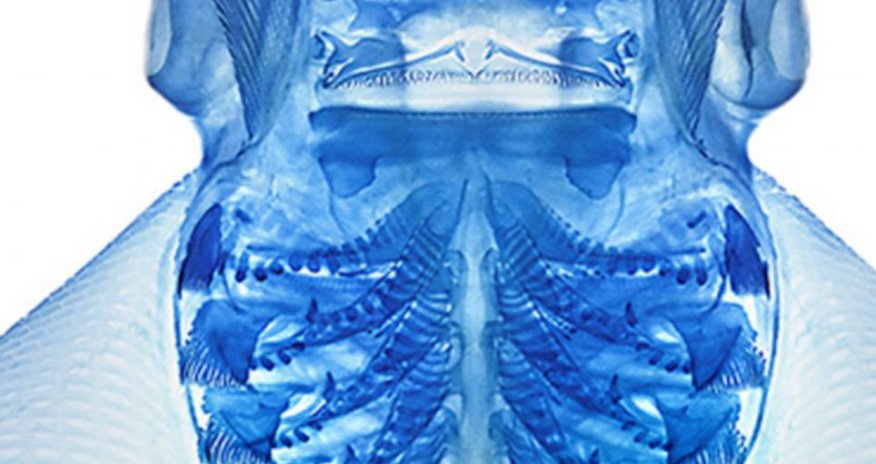
Fish are often classed as ugly, slimy creatures but these latest images reveal their inner beauty.Each of the marine specimens have been bleached to make the skin clear and then stained to expose their complex and elegant skeletons.They include the Spiny Lumpsucker, the Little Skate and the Butterfly Ray and form part of the Cleared exhibition due to go on display in Seattle in March. The project was created by Professor Adam Summers, associate director of Comparative Vertebrate Biomechanics at Washington University. He collected the specimens from various fisheries, with many having died during scientific studies. One study, for example, had focused on the developmental trajectory of the fish skeleton.The fish were treated at the Biomechanics Lab at Friday Harbour in Washington. Each fish was stained using two specific dyes - Alcian Blue to stain the cartilaginous elements deep blue, and Alizarin Red S to turn the tissue a crimson colour. The fish were then bleached in hydrogen peroxide to remove any dark pigments.Flesh from the specimens were dissolved in a digestive enzyme called Trypsin which removed the protein, but left the collagen that holds the bones and skin together intact.To make the fish appear invisible, each specimen was then submerged in glycerine and placed into various poses before being photographed using a Canon 5D Mark III camera fitted with a 100mm Macro lens.Professor Summers told Seattle Aquarium, where the display is being held: ‘This technique is only effective on specimens that are less than about 1cm in thickness, and takes much longer for thick specimens than thin. 'A small fish might take three days to process while a larger animal could take several months.'Professor Summers continued that he has a camera on a tripod and uses a remote shutter release to take the shots each time. To make sure the glycerine is still, Professor Summers said he poses the fish and leaves the set up for several hours before taking the images.The glycerine is placed on a colour corrected LED light table to highlight the specimens.There are 14 specimens in total in the display. The six featured here include the Spiny Lumpsucker, Little Skate, Scalyhead Sculpin, Butterfly Ray and Whitespotted Greenling.(dailymail.co.uk)ANN.Az


Similar news
Similar news











 Photo
Photo 



 Video
Video