





Saturn's moon shows sign of life
12.03.2015 19:59


Scientists have revealed a huge breakthrough in the search for life on other planets.
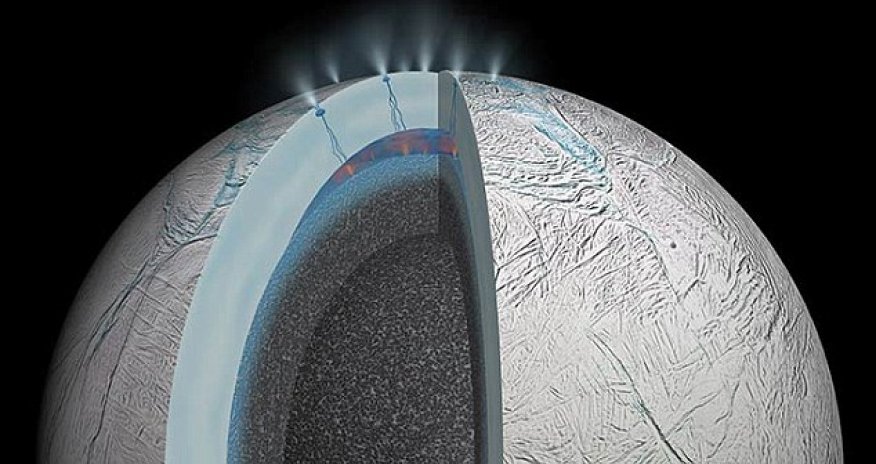
Nasa's Cassini spacecraft has provided scientists the first clear evidence that Saturn's moon Enceladus exhibits signs of present-day hydrothermal activity - similar to that seen in the deep oceans on Earth.
If confirmed, it would make the moon Enceladus the only other known body in the solar system besides Earth where hot water and rocks interact underground.
That activity would make the moon an even more attractive place in the hunt for microbial life.
On Earth, scientists have found weird life forms living in hydrothermal vents on the ocean bottom where there's no sunlight.
The implications of such activity on a world other than our planet open up unprecedented scientific possibilities, Nasa said.
'These findings add to the possibility that Enceladus, which contains a subsurface ocean and displays remarkable geologic
activity, could contain environments suitable for living organisms,' said John Grunsfeld astronaut and associate administrator of NASA's Science Mission Directorate in Washington.
'The locations in our solar system where extreme environments occur in which life might exist may bring us closer to answering the question: are we alone in the Universe.'
Hydrothermal activity occurs when seawater infiltrates and reacts with a rocky crust and emerges as a heated, mineral-laden solution, a natural occurrence in Earth's oceans.
According to two science papers, the results are the first clear indications an icy moon may have similar ongoing active processes.
The first paper, published this week in the journal Nature, relates to microscopic grains of rock detected by Cassini in the Saturn system.
An extensive, four-year analysis of data from the spacecraft, computer simulations and laboratory experiments led researchers to the conclusion the tiny grains most likely form when hot water containing dissolved minerals from the moon's rocky interior travels upward, coming into contact with cooler water.
Temperatures required for the interactions that produce the tiny rock grains would be at least 194 degrees Fahrenheit (90 degrees Celsius).
'It's very exciting that we can use these tiny grains of rock, spewed into space by geysers, to tell us about conditions on -- and beneath -- the ocean floor of an icy moon,' said the paper's lead author Sean Hsu, a postdoctoral researcher at the University of Colorado at Boulder.
Cassini's cosmic dust analyzer (CDA) instrument repeatedly detected miniscule rock particles rich in silicon, even before Cassini entered Saturn's orbit in 2004.
By process of elimination, the CDA team concluded these particles must be grains of silica, which is found in sand and the mineral quartz on Earth.
The consistent size of the grains observed by Cassini, the largest of which were 6 to 9 nanometers, was the clue that told the researchers a specific process likely was responsible.
On Earth, the most common way to form silica grains of this size is hydrothermal activity under a specific range of conditions; namely, when slightly alkaline and salty water that is super-saturated with silica undergoes a big drop in temperature.
'We methodically searched for alternate explanations for the nanosilica grains, but every new result pointed to a single, most likely origin,' said co-author Frank Postberg, a Cassini CDA team scientist at Heidelberg University in Germany.
Hsu and Postberg worked closely with colleagues at the University of Tokyo who performed the detailed laboratory experiments that validated the hydrothermal activity hypothesis.
The Japanese team, led by Yasuhito Sekine, verified the conditions under which silica grains form at the same size Cassini detected.
The researchers think these conditions may exist on the seafloor of Enceladus, where hot water from the interior meets the relatively cold water at the ocean bottom.
The extremely small size of the silica particles also suggests they travel upward relatively quickly from their hydrothermal origin to the near-surface sources of the moon's geysers.
From seafloor to outer space, a distance of about 30 miles (50 kilometers), the grains spend a few months to a few years in transit, otherwise they would grow much larger.
The authors point out that Cassini's gravity measurements suggest Enceladus' rocky core is quite porous, which would allow water from the ocean to percolate into the interior.
This would provide a huge surface area where rock and water could interact.
The second paper, recently published in Geophysical Research Letters, suggests hydrothermal activity as one of two likely sources of methane in the plume of gas and ice particles that erupts from the south polar region of Enceladus.
The finding is the result of extensive modeling to address why methane, as previously sampled by Cassini, is curiously abundant in the plume.
The team found that, at the high pressures expected in the moon's ocean, icy materials called clathrates could form that imprison methane molecules within a crystal structure of water ice.
Their models indicate that this process is so efficient at depleting the ocean of methane that the researchers still needed an explanation for its abundance in the plume.
(dailymail.co.uk)
ANN.Az


Similar news
Similar news












 Photo
Photo 



 Video
Video