





Neanderthal who fell down sinkhole 150,000 years ago
21.04.2015 10:47


It was a gruesome death that is the stuff of most people's nightmares.
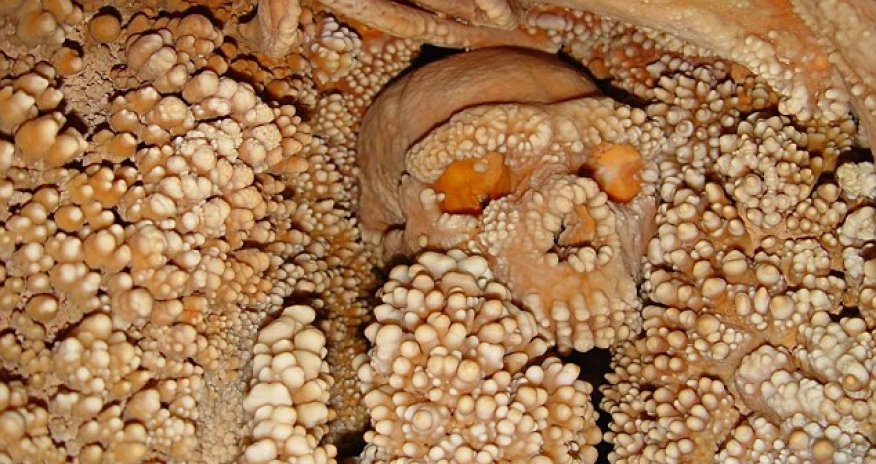
Now scientists have identified the unfortunate individual whose bones were found fused to the walls of a cave in Lamalunga, near Altamura, in southern Italy.
Using analysis of DNA extracted from the bones sticking out from the limestone rock, researchers have found he was a Neanderthal who fell down a sinkhole around 150,000 years ago.
Wedged in the narrow space and probably badly injured, he is thought to have starved to death.
Over the thousands of years that followed, the body decayed and the remaining bones gradually became incorporated into the stalactites left behind by water dribbling down the cave walls.
First discovered in 1993, the skeleton - nicknamed 'Altamura Man' - has provoked debate among anthropologists partly due to the difficulties in studying the skeleton as it had become part of the cave walls.
Examination of those bones that were exposed suggested they belonged to an adult male.
However, few could agree on whether the skeleton belonged to a Neanderthal or a modern human, or how long it had been down there.
But after taking a tiny part of the skeleton's shoulder bone, researchers at the Sapienza University of Rome, University of Firenze and Newcastle University have been able to answer the questions.
They found mitochondrial DNA they extracted from the shoulder bone matched that of other Neanderthal skeletons.
Uranium-thorium dating techniques has also revealed that the skeleton appeared there between 172,000 and 130,000 years ago, during a period when ice sheets were expanding significantly from out of Antarctica and Greenland.
Giorgio Manzi, one of the palaeoanthropologists leading the study from the Sapienza University of Rome, said: 'Altamura Man is an incredible treasure for the Alta Murgia territory.
'We hope that this fossil skeleton will become a key for a virtuous combination of scientific research, protection of our heritage and its promotion and development.'
The researchers now hope that further analysis of the DNA might reveal new insights into Neanderthal evolution.
It is nearly 100,000 years older than other previously sequenced Neanderthal DNA.
The Altamura Neanderthal is thought to have come to rest in its unusual tomb after an adult male fell down a sinkhole into a limestone karst system.
Wedged in the narrow rocks, he were unable to move and probably starved to death. However, it also means no predators were able to reach his body.
Over time, his bones fell where had died, with some still lodged in the cave gap and were eventually absorbed into the walls of the cave itself.
Cave explorers then stumbled across the bones in 1993. Researchers eventually obtained permission to take a fragment of the shoulder bone in 2009 and have spent six years studying it.
(dailymail.co.uk)
www.ann.az


Similar news
Similar news












 Photo
Photo 



 Video
Video