





The most extreme fish on Earth
22.05.2015 19:30


When we think of fish, there are certain assumptions we make.
There are male fish, and female fish, and these fish mate to create little fish, which inherit traits from both parents.
Over a few years, the little fish grow and grow, until they become old fish.
Fish breathe using their gills.
Fish also live in water. We take that one for granted – hence the phrase "a fish out of water", meaning something weird or odd, something that shouldn't be.
Fish can't live out of water.
And to get about, they swim, ideally in huge expanses of water, such as rivers, lakes, seas and oceans.
However, there is one group of fish that does not follow any of these rules.
Known as killifish, these small innocuous-looking creatures measure just a few inches long.
Many species are flamboyant and kept as pets in aquaria. But others look ordinary, and in their own way are among the oddest fish on the planet A few can claim to be the world's most extreme.
That's because some killifish don't reproduce like other fish. In fact, one species doesn't reproduce in the same way as any other vertebrate.
Killifish don't like to grow old – well, not old in the conventional sense. They don't mature like other fish, and many killifish species will live and die with a year. One species survives for less than three months, making it among the shortest-lived of all known vertebrates.
They have other ways of breathing, apart from using their gills.
And swimming isn't really their thing. They prefer to live puddles and pools, and have evolved their whole life strategy to cope without water, rather than with it.
Some species can survive out of water for more than two months. They will leave it to go for a walk and they even hunt on land.
Some have even been found living in trees…
Living without water
There are a number of killifish species living across Africa and South America. Most are adapted to living in places where water is scarce, or where water levels change drastically from season to season.
Some do live in larger bodies of water, but many survive in isolated pools, created as lakes and rivers periodically dry.
That creates a fundamental challenge – how do the fish survive and reproduce when the water eventually runs out?
A new review of how killifish do this has just been published in the journal Biological Reviews by Andrew Furness at the University of California, Riverside in the US.
One major adaption, which different killifish species have independently evolved, is to live their whole lives within a single year, using a number of unique tricks.
During the wet season, when pools are full, the fish hatch. They quickly grow to maturity and start spawning, which they keep doing until the pools start to dry. At that point all the fish perish.
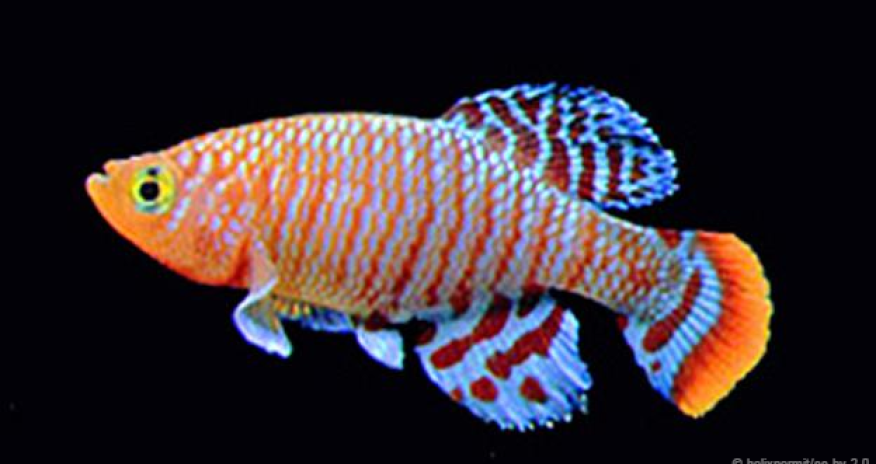
This cycle of life can be so quick that one species, the turquoise killifish (Nothobranchius furzeri) of equatorial Africa, lives for an average of just 10 weeks.
But they leave behind eggs in the soil, and these eggs represent the entire surviving populations of killifish.
These eggs survive the dry season in a dormant state, or diapause, buried in the soil until the following rainy season. The return of the rains causes eggs to hatch and the cycle begins anew, says Furness.
To do this, different killifish are able to stopping growing as embryos, and then start again when conditions are right. And they can stop at different times during their development, delaying the growth of major organs, such their skulls, hearts and circulatory systems. They can then delay hatching for days, weeks or months.
Other killifish have evolved other extreme lifestyles.
The mangrove killifish (Kryptolebias marmoratus), for example, is a hermaphrodite, possessing both male and female sex organs. Other animals can do that. But it also sports what is known as an intromittent sexual organ, which it inserts into another individual to fertilise eggs internally. That's more rare in fish, which usually lay eggs that are externally fertilised by sperm in the water. Other vertebrates can do that too.
But the mangrove killifish is the only known vertebrate hermaphrodite that can fertilise itself, producing genetically identical clones. And just to mix it up a bit, a few male mangrove killifish do exist, which mate in a more conventional sexual fashion with other hermaphrodites, which act as females.
Most fish breathe with their gills, passing water over them to extract oxygen. The mangrove killifish however, can also breathe through its skin.
That’s critical for the fish's survival as mangrove killifish live in the most extreme habitat, within the mangrove forests of the west Atlantic, a tangle of thick tree roots and deep mud.
Decaying leaves from red mangrove trees sink into the mud, and are broken down by bacteria. They spew out noxious hydrogen sulphide gas, and the water contains little oxygen.
Other fish species frequent mangroves, but they usually move in and out as water conditions vary. Mangrove killifish spend their whole lives here. This water then disappears during the dry season, leaving the fish high and dry.
Some survive in diminishing pools, while others are left clinging to the mud or tree branches. Essentially, the fish have moved onto land as the water recedes, and survive by breathing air through their skin. They even excrete waste through their skin and tests have shown that mangrove killifish can survive out of water for up to 66 days.
(BBC)
www.ann.az


Similar news
Similar news












 Photo
Photo 



 Video
Video